UPDATE: NASA has confirmed that the reaction wheels of its Lunar Atmosphere and Dust Environment Explorer (LADEE) were successfully brought back on-line and the spacecraft has acquired its safe-mode attitude profile.
Last night during technical checkouts the LADEE spacecraft commanded itself to shut down the reaction wheels used to position and stabilize the spacecraft. According to the LADEE mission operations team at NASA’s Ames Research Center in Moffett Field, Calif., this was determined to be the result of fault protection limits put in place prior to launch to safeguard the reaction wheels. The limits that caused the powering off of the wheels soon after activation were disabled, and reaction wheel fault protection has been selectively re-enabled.
“Our engineers will determine the appropriate means of managing the reaction wheel fault protection program. Answers will be developed over time and will not hold up checkout activities,” said Butler Hine, LADEE project manager.
“The initial checkout flight procedure is progressing,” said S. Pete Worden, Ames center director. “The reaction wheel issue noted soon after launched was resolved a few hours later. The LADEE spacecraft is healthy and communicating with mission operators.”
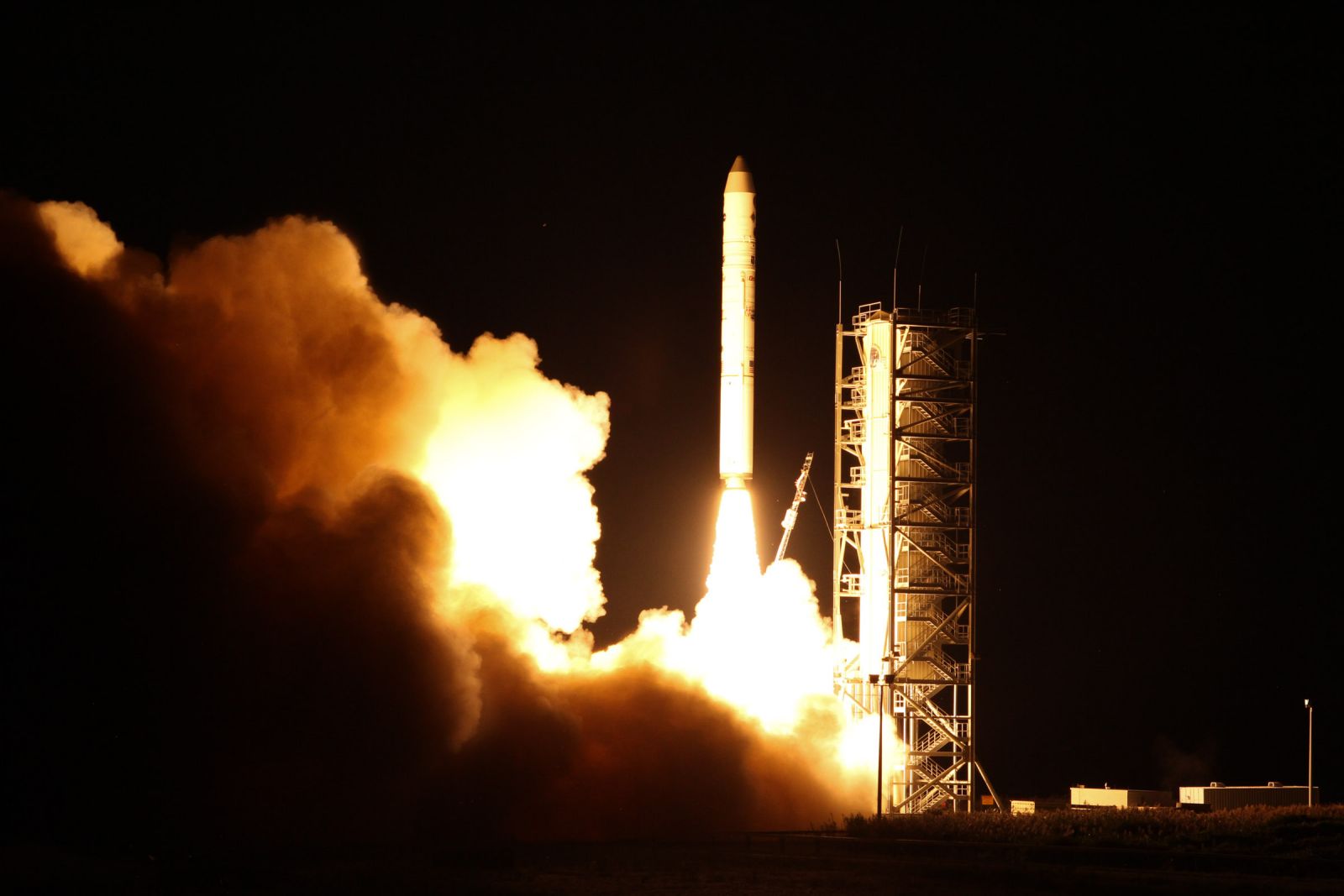
NASA’s Lunar Atmosphere and Dust Environment Explorer (LADEE) spacecraft was lofted into a lunar insertion trajectory on the inaugural flight of the Minotaur V launch vehicle manufactured by Orbital Sciences Corporation. Originating from the Mid-Atlantic Regional Spaceport at NASA’s Wallops Flight Facility in eastern Virginia late yesterday, the LADEE mission was also the fifth rocket in the Minotaur family of vehicles to be launched from the Wallops facility.
“The Minotaur V design builds on Orbital’s proven systems engineering, production, test and flight operations supporting the Minotaur family of rockets, creating another cost-effective launch alternative for U.S. government space missions,” said Mr. Lou Amorosi, Senior Vice President of Orbital’s Small Space Launch Vehicle business. “We look forward to the successful launch of the LADEE orbiter and the opportunity to continue supporting NASA in its exploration and science missions.”
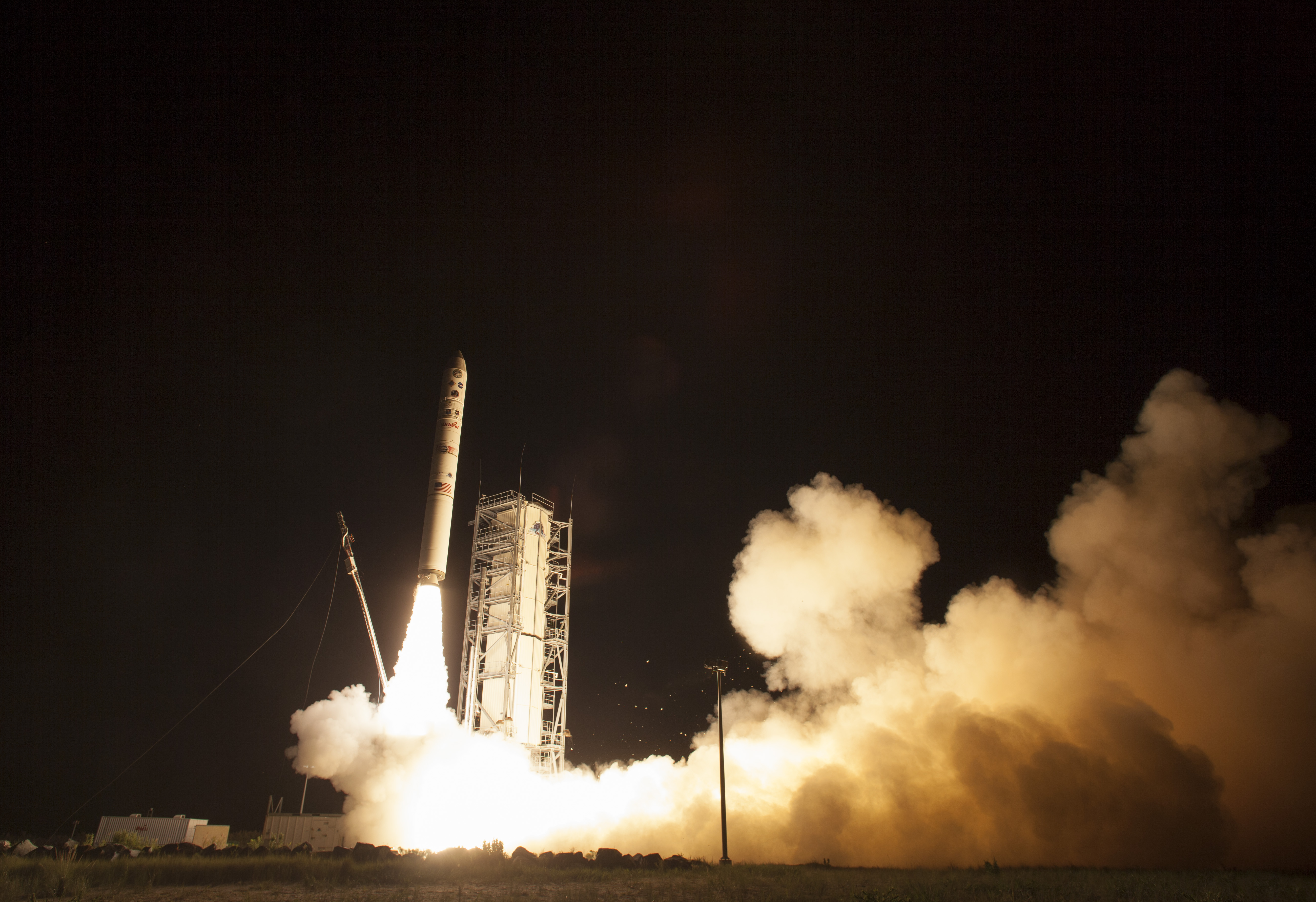
The first stage of Minotaur V ignited at 11:27 p.m. (EDT) and separated the LADEE spacecraft 23 minutes later into its intended insertion point, successfully completing the rocket’s five-stage sequence. With the placement of LADEE into its highly elliptical orbit, the spacecraft began its 30-day journey to the Moon. Upon reaching its nominal orbit approximately 31 miles above the lunar surface, LADEE will collect data on the Moon’s exosphere and lunar dust environment. It will also gather information derived from new laser communications technologies, which will likely prove beneficial for future deep space missions.
“The launch of NASA’s LADEE spacecraft aboard our new Minotaur V rocket was a tremendous success, building on our exemplary track record with today’s 24th fully successful Minotaur launch,” said Amorosi. “This mission further demonstrates the capabilities of our well-established Minotaur rocket family and our commitment to providing reliable access to space.”
NASA’s Lunar Atmosphere and Dust Environment Explorer (LADEE, pronounced like “laddie”) is a robotic mission that will orbit the moon to gather detailed information about the lunar atmosphere, conditions near the surface and environmental influences on lunar dust. A thorough understanding of these characteristics will address long-standing unknowns, and help scientists understand other planetary bodies as well.
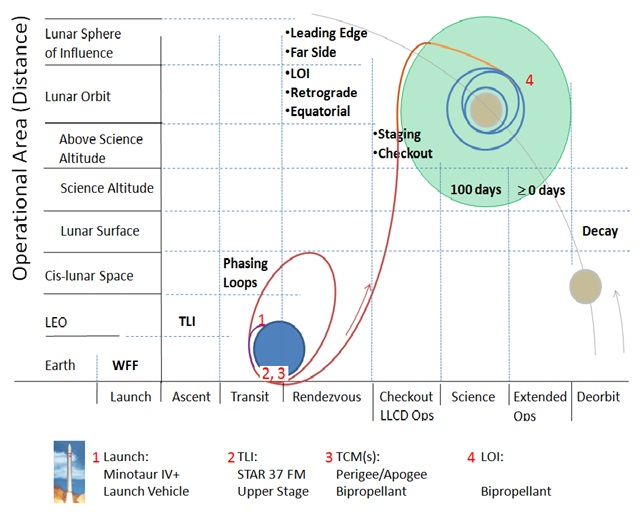
LADEE’s mission is planned for a 100-day Science Phase. During the Science Phase, the moon will rotate more than three times underneath the LADEE orbit.
At the start of the Science Phase, the LADEE spacecraft will be in a nearcircular orbit with an altitude of about 12 – 93 miles (20 – 150 kilometers). During the Science Phase, LADEE will orbit between 111.5 and 116.5 minutes. Due to the unevenness of the Moon’s gravitational field, the 50 x 50 km orbit requires significant orbit maintenance activity with maneuvers taking place as often as every 3-5 days or as infrequently as once every two weeks. Orbit Maintenance Maneuvers will be used to keep LADEE’s lowest altitude above 31 miles (50 kilometers) and highest altitude below 93 miles (150 kilometers) to the extent possible. Orbital Maintenance Maneuvers are designed to maintain the altitude over the lunar sunrise terminator whenever possible.
The science orbit is designed to satisfy the basic science requirements of the LADEE mission, which are for a low-altitude, nearcircular, equatorial orbit. The primary design parameter from a science perspective is the orbit altitude, since sensitivity to the lunar atmosphere is driven by orbit altitude (i.e. the lower the altitude, the more sensitive the science measurements). Limits on the minimum orbit altitude are driven primarily by orbit lifetime considerations.
The Minotaur V is a five-stage space launch vehicle designed, built and operated by Orbital for the U.S. Air Force. It uses three decommissioned Peacekeeper government-supplied booster stages that Orbital combines with commercial motors for the upper two stages to produce a low-cost rocket for launching smaller spacecraft into low-Earth orbit and higher-energy trajectories, such as the trans-lunar flight of the LADEE mission.
Under the Orbital/Suborbital Program (OSP) contract, which is managed by the U.S. Air Force Space and Missile Systems Center (SMC), Space Development and Test Directorate (SMC/SD) Launch Systems Division (SMC/SDL) located at Kirtland Air Force Base, New Mexico, Orbital designs, integrates, tests and provides launch services to orbit with the Minotaur I, IV, V and VI rockets, as well as other suborbital capabilities with the Minotaur II and III configurations. The company has launched a total of 23 Minotaur rockets with a 100% success record dating back to January 2000.
Employing a combination of U.S. government-supplied rocket motors and Orbital’s proven commercial launch technologies, the Minotaur family of launchers provides low-cost access to space for government-sponsored payloads. The rockets are specifically designed to be capable of launching from all major U.S. spaceports, including government and commercial launch sites in Alaska, California, Virginia and Florida. Orbital’s use of standardized avionics and subsystems, mature processes and experienced personnel make Minotaur rockets both reliable and cost-effective for U.S. government customers.
In addition to the Minotaur V rocket, the product line includes:
- Minotaur I – The initial member of the Minotaur family, the Minotaur I is a four-stage space launch configuration that can place up to 1,300 lbs. into low-Earth orbit. It was originally launched in January 2000 and has conducted a total of 10 successful launches to date.
- Minotaur II – A three-stage suborbital rocket, the Minotaur II is used as a target vehicle for testing U.S. missile defense systems and related missions. This configuration has performed eight successful launches to date.
- Minotaur III – A three-stage suborbital rocket, Minotaur III can deliver suborbital technology demonstration payloads of up to 6,500 lbs. or serve as a target vehicle for testing U.S. missile defense systems and similar missions.
Minotaur IV – A heavier-lift four-stage space launch vehicle using retired Peacekeeper rocket motors, the Minotaur IV is capable of launching satellites weighing up to 3,800 lbs. into low-Earth orbit. Five successful launches have been conducted with this configuration. - Minotaur VI – An evolutionary version of the flight-proven Minotaur IV, the Minotaur VI provides a highly-capable and cost-effective launcher for U.S. Government-sponsored spacecraft of up to 7,000 lbs. into low-Earth orbit. The combination of four government-furnished solid rocket stages, a commercial solid rocket upper stage, and Orbital’s flight-proven systems and processes provide unmatched value and performance.


