Plasma Diagnostics Package (PDP) grappled by remote manipulator system
(RMS) end effector is positioned above payload bay (PLB) at sunrise.
Commander Lousma, wearing communications kit assembly (ASSY) mini headset
(HDST), records Plant Growth Unit (PGU) data for the Influence of
Weightlessness on Plant Lignification Experiment at forward middeck locker
MF14K. The experiment is designed to demonstrate the effect of
weightlessness on the quantity and rate of lignin formation in different
plant species during early stages of development. Port side bulkhead with
window shade and filter kit appears behind Lousma and potable water tank
below him. Trash bag also appears in view.
Pilot Fullerton, wearing communication kit assembly (assy) mini headset
(HDST), sleeps on aft flight deck resting his back against the floor and
his feet against Commanders ejection seat (S1) seat back. Onorbit Station
control panel A8 and Payload Station panel L15 appear above Fullerton.
Special clips for holding notebooks open and beverage containers are
velcroed on various panels.
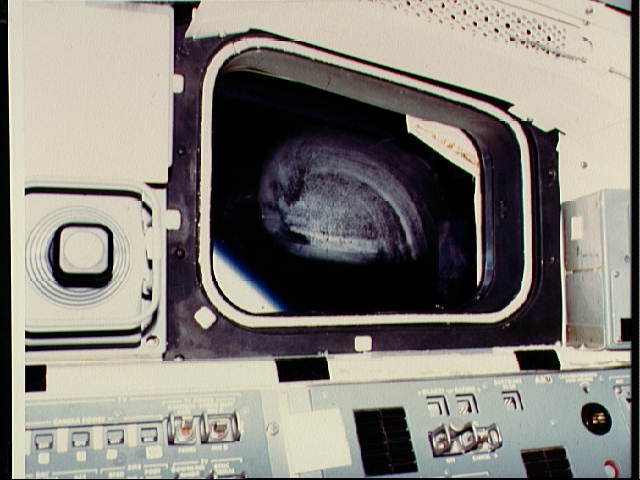
Crew compartment aft flight deck viewing window W10 fogged with
condensation. The condensation is a result of the spacecraft’s position in
relation to the sun.
A panaramic view of eastern Egypt, The Red Sea and Saudi Arabia beyond
(24.0N, 33.0E). In this desert country, where water is life, the high
Aswan Dam and the impounded waters of the Nile River in the foreground
assure water availability into the next century. The Red Sea beyond, part
of the Suez Canal seaway, serves as a commercial link to the world and
separates Egypt from Saudi Arabia.
The southern part of Iraq (30.0N, 48.0E) at the Hawr al Hammar lakes and
marshlands where the mouths of the Tigris and Euphrates Rivers enter the
northern Persian Gulf and serve as a border between Iraq and Iran seen at
the left. The neighboring oil rich countries of Kuwait and Saudi Arabia
are at the headwaters of the Gulf and extend into the background.
Pilot Fullerton, wearing communications kit assembly (ASSY) mini headset
(HDST), uses hygiene kit hair brush on aft middeck. He makes light of his
lack of hair during a freshening up session. He makes a token effort with
a hair brush. Side hatch and panel ML31C appear behind him.
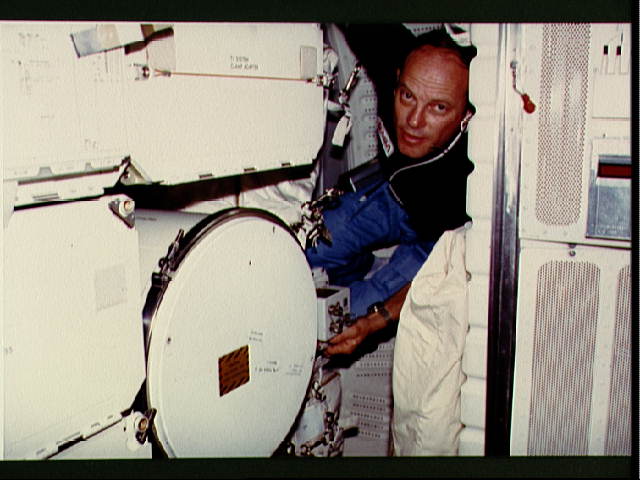
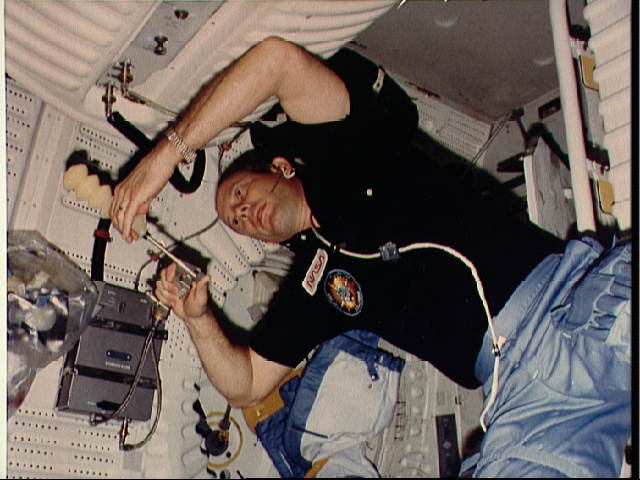
Commander Lousma, wearing communications kit assembly (ASSY) mini headset
(HDST), adjusts controls on MonodisperseLatex Reactor (MLR) experiment
located in forward middeck lockers MF57H and MF57K. To reach MLR support
electronics assy controls, Lousma squeezes in between forward lockers and
Development Flight Instrument (DFI) unit on starboard bulkhead.
Pilot Fullerton, wearing communications kit assembly (ASSY) mini headset
(HDST), reviews flight data file (FDF) checklist and text and graphics
system (TAGS) printout (ticker tape) while in pilots ejection seat (S2).
Pilot Station control panels F4, F7, F8, O3, window shade, and portable
oxygen system (POS) assy appear in view.
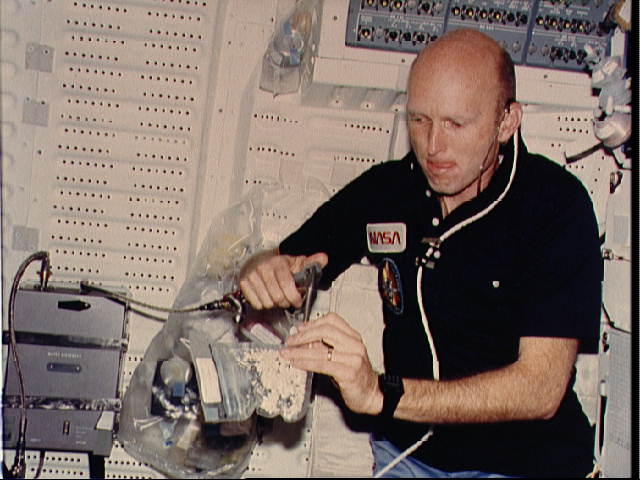
Pilot Fullerton, wearing communications kit assembly (assy) mini headset
(HDST), prepares meal on middeck. Fullerton clips corner of rehydratable
food (cereal) package with scissors. The opening will allow Fullerton to
insert JSC water dispenser kit water gun in order to heat contents with hot
water. Meal tray assembly is secured to forward middeck locker and holds
additional food packages and beverage containers.
A general view of the greater Los Angeles region of California (34,0N,
118.5W) showing the coastline, Vandenberg AFB, the south end of the Central
Valley and the dry lake beds at Edwards AFB, landing site of the space
shuttle.
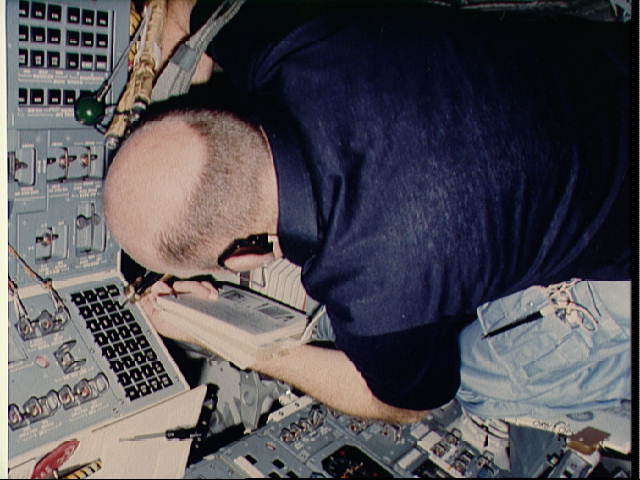
Pilot Fullerton, wearing communication kit assembly (ASSY) mini headset
(HDST) and using a screwdriver and flashlight (penlight), replaces SPEC key
on forward flight deck control panel C2 commanders side keyboard.
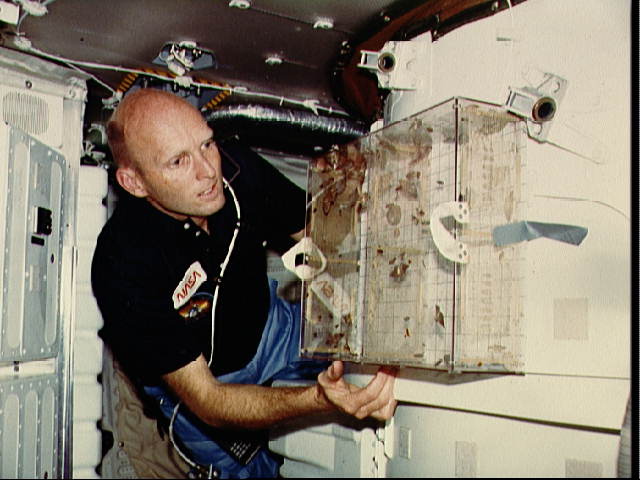
Pilot Fullerton examines Student Experiment 81-8 (SE-81-8) Insect Flight
Motion Study taped to the airlock on aft middeck. Todd Nelson, a high
school senior from Minnesota, won a national contest to fly his experiment
on this particular flight. Moths, flies, and bees were studied in the
near weightless environment.
Commander Lousma, wearing communication kit assembly (ASSY) mini headset
(HDST), gathers three freefloating plastic trash bags filled with empty
containers, paper towels, straws, etc. Lousma will stow them in a
designated stowage volume.
Commander Lousma, wearing communications kit assembly (assy) mini headset
(HDST), fills beverage container using the JSC water dispenser kit water
gun to prepare a juice drink. Lousma is wearing the trousers and shirt of
a three-piece shuttle constant wear garment as he floats above the potable
water tank on the middeck floor. The constant wear garment jacket is
secured on a side hatch handle (background) to avoid zero gravity effect.
Pilot Fullerton dons ejection escape suit (EES) (high altitude pressure
garment) life preserver unit (LPU) on forward port side of middeck above
potable water tank. Fullerton also adjusts lapbelt fitting and helmet
holddown strap.
Pilot Fullerton, wearing communications kit assembly (assy) mini headset
(HDST), inserts the JSC water dispenser kit water gun in rehydratable
plastic food (cereal) package to fill it with hot water.
Pilot Fullerton, wearing communications kit assembly (ASSY) mini headset
(HDST), points Hasselblad camera out forward flight deck pilots station
window W6. Forward flight deck control panels F4, F8, and R1, flight
mirror assy, Volume R5 Kit, and pilots ejection seat (S2) headrest appear
in view.
Pilot Fullerton, wearing communications kit assembly (ASSY) mini headset
(HDST) and ejection escape suit (EES), holds flexible hose attached to his
EES vent hose fitting and second hose for commanders EES while behind
pilots ejection seat (S2) seat back on the aft flight deck. Forward
flight deck control panels are visible in the background.
Pilot Fullerton dons ejection escape suit (EES) anti-gravity (anti-g) suit
lower torso on forward port side middeck above potable water tank. Anti-g
suit is an olive drab inner garment that complements EES.
Pilot Fullerton, wearing communication kit assembly (ASSY) mini headset
(HDST) and using a screwdriver and flashlight (penlight), replaces
acknowledge (ACK) key on aft flight deck mission station control panel
R12L keyboard.
Commander Lousma uses his body as a zero gravity garbage compactor to stow
plastic bags full of empty containers and trash in the Carbon Dioxide (CO2)
Absorber Stowage volume in front of the airlock hatch.
Commander Lousma, tethered to panel A12, sleeps on aft flight deck
starboard side. Pilots ejection seat (S2) seat back with portable oxygen
system (POS) assemby, Onorbit Station control panels, and Mission Station
control panels surround Lousma. Window shade is in place in overhead
window W7 just above his feet.
A truly remarkable view of White Sands and the nearby Carrizozo Lava Beds
in southeast NM (33.5N, 106.5W). White Sands, site of the WW II atomic
bomb development and testing facility and later post war nuclear weapons
testing that can still be seen in the cleared circular patterns on the
ground. Space Shuttle Columbia, this mission, landed at the White Sands
alternate landing site because of bad weather at Edwards AFB, CA.
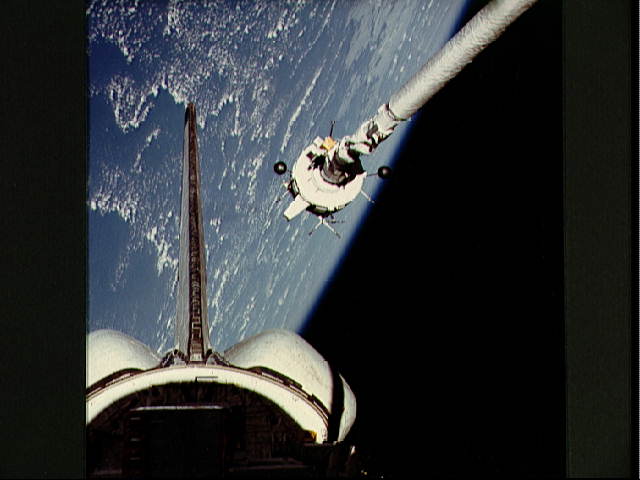
The Remote Manipulator System (RMS) arm is deployed from its stowed
position on the port side longeron of the space shuttle and lifted above
the payload bay (PLB) with ocean and clouds of the Earth’s surface
appearing in the background. The Plasma Diagnostics Package (PDP) is
attached to the RMS end effector.
A northern hemisphere tropical storm or hurricane over open ocean –
location unknown, can be seen in the early stages of forming by the loosly
defined cyclonic spiral gyre and eye within the cumulonimbus clouds. The
storm can be readily identified as being in the northern hemisphere by the
counter- clockwise rotation of the gyre. Because of the Earth’s rotation
induced coriolis effect, all northern hemisphere cyclonic circulations
rotate in a counter-clockwise spiral and all those in the southern
hemisphere rotate in a clockwise spiral.
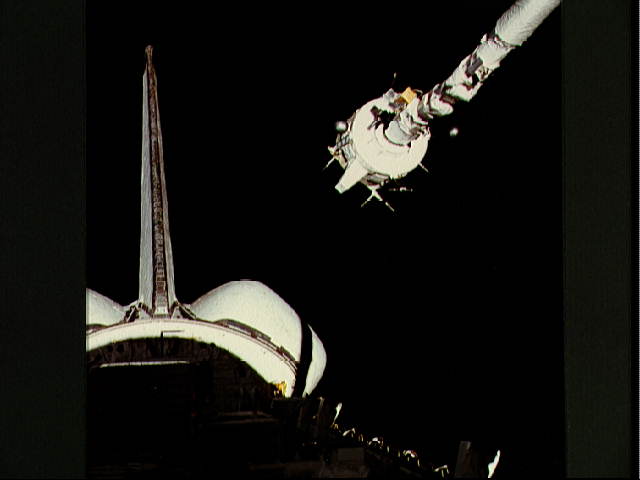
This the aft section of the Earth-orbiting Columbia’s cargo bay and the
remote manipulator system (RMS) moving the plasma diagnostics package
(PDP) was photographed through the flight-deck’s aft windows during the
STS-3 flight. Visible at the lower left of the photo are the twin orbital
maneuvering system (OMS) pods. The vertical stabilizer or tail splits the
top part of the image in half. The RMS, with its camera attached to the
wrist, is aimed in the direction of the dark payload bay.
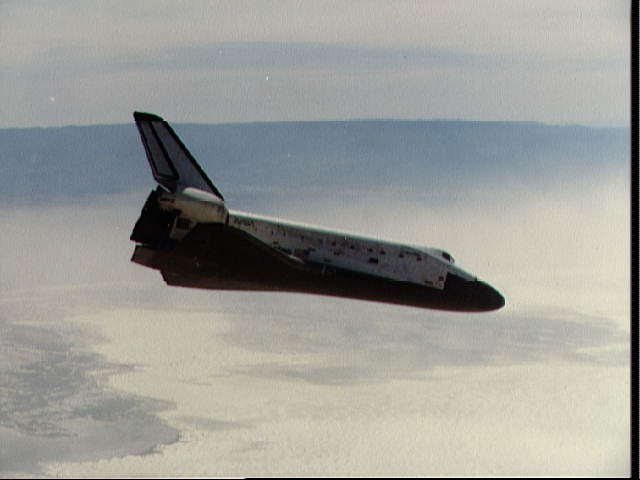
View of the underside of the orbiter as it makes its descent during the
touchdown at the Northrup Strip, New Mexico (28835); side view of Columbia
on approach to the Northrup Strip on the White Sands Missile Range
(28836); Columbia on approach to the Northrup Strip. In the uppers left
hand corner a T-38 chase plane is visible (28837); Columbia touches down
on the Northrup Strip at White Sands (28838); Columbia is shown seconds
from touchdown with two T-38 chase planes following it in to the landing
strip (28839); T-38 chase planes remain relatively close to the Shuttle
orbiter Columbia as it makes its descent to the landing site in New Mexico
(28840).
View of the underside of the orbiter as it makes its descent during the
touchdown at the Northrup Strip, New Mexico (28835); side view of Columbia
on approach to the Northrup Strip on the White Sands Missile Range
(28836); Columbia on approach to the Northrup Strip. In the uppers left
hand corner a T-38 chase plane is visible (28837); Columbia touches down
on the Northrup Strip at White Sands (28838); Columbia is shown seconds
from touchdown with two T-38 chase planes following it in to the landing
strip (28839); T-38 chase planes remain relatively close to the Shuttle
orbiter Columbia as it makes its descent to the landing site in New Mexico
(28840).
View of the underside of the orbiter as it makes its descent during the
touchdown at the Northrup Strip, New Mexico (28835); side view of Columbia
on approach to the Northrup Strip on the White Sands Missile Range
(28836); Columbia on approach to the Northrup Strip. In the uppers left
hand corner a T-38 chase plane is visible (28837); Columbia touches down
on the Northrup Strip at White Sands (28838); Columbia is shown seconds
from touchdown with two T-38 chase planes following it in to the landing
strip (28839); T-38 chase planes remain relatively close to the Shuttle
orbiter Columbia as it makes its descent to the landing site in New Mexico
(28840).
View of the underside of the orbiter as it makes its descent during the
touchdown at the Northrup Strip, New Mexico (28835); side view of Columbia
on approach to the Northrup Strip on the White Sands Missile Range
(28836); Columbia on approach to the Northrup Strip. In the uppers left
hand corner a T-38 chase plane is visible (28837); Columbia touches down
on the Northrup Strip at White Sands (28838); Columbia is shown seconds
from touchdown with two T-38 chase planes following it in to the landing
strip (28839); T-38 chase planes remain relatively close to the Shuttle
orbiter Columbia as it makes its descent to the landing site in New Mexico
(28840).
View of the underside of the orbiter as it makes its descent during the
touchdown at the Northrup Strip, New Mexico (28835); side view of Columbia
on approach to the Northrup Strip on the White Sands Missile Range
(28836); Columbia on approach to the Northrup Strip. In the uppers left
hand corner a T-38 chase plane is visible (28837); Columbia touches down
on the Northrup Strip at White Sands (28838); Columbia is shown seconds
from touchdown with two T-38 chase planes following it in to the landing
strip (28839); T-38 chase planes remain relatively close to the Shuttle
orbiter Columbia as it makes its descent to the landing site in New Mexico
(28840).
View of the underside of the orbiter as it makes its descent during the
touchdown at the Northrup Strip, New Mexico (28835); side view of Columbia
on approach to the Northrup Strip on the White Sands Missile Range
(28836); Columbia on approach to the Northrup Strip. In the uppers left
hand corner a T-38 chase plane is visible (28837); Columbia touches down
on the Northrup Strip at White Sands (28838); Columbia is shown seconds
from touchdown with two T-38 chase planes following it in to the landing
strip (28839); T-38 chase planes remain relatively close to the Shuttle
orbiter Columbia as it makes its descent to the landing site in New Mexico
(28840).
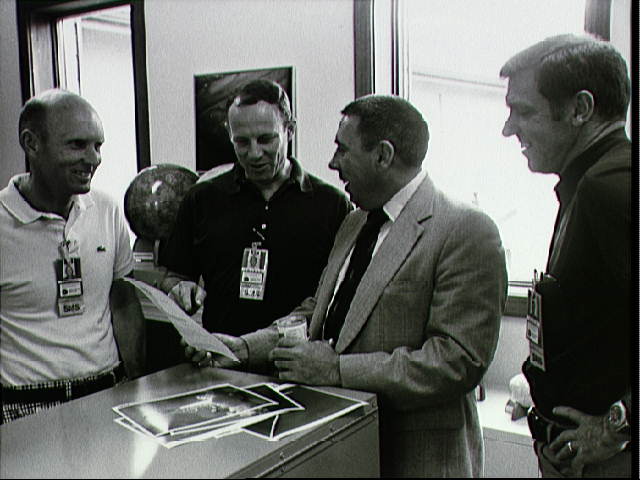
Views of STS-3 crew during debriefing sessions. During a break from these
sessions, the STS-3 prime crew looks over some of the photography of their
launch from the Kennedy Space Center along with other participants of the
meeting. Astronaut Jack R. Lousma is second from left; Astronaut C. Gordon
Fullerton is at left. George W. S. Abbey, director of flight operations at
JSC, is second from right and astronaut Joe H. Engle, STS-2 commander, is
at right (28950); Lousma, right and Fullerton joke during debriefing
session (28951); crewmembers from STS-2 and STS-4 meet with STS-3
astronauts for a debriefing seesion. Taking notes at bottom left
foreground is Astronaut John W. Young, STS-1 commander and chief of the
Astronaut Office at JSC. Clockwise around the table, beginning with Young
are George W.S. Abbey, Astronauts Joe E. Engle, STS-2 commander; Henry W.
Hartsfield, Jr., STS-4 pilot; C. Gordon Fullerton, Jack R. Lousma, Thomas
K. (Ken) Mattingly, STS-4 commander; and Richard H. Truly, STS-2 pilot
(28952).
Views of STS-3 crew during debriefing sessions. During a break from these
sessions, the STS-3 prime crew looks over some of the photography of their
launch from the Kennedy Space Center along with other participants of the
meeting. Astronaut Jack R. Lousma is second from left; Astronaut C. Gordon
Fullerton is at left. George W. S. Abbey, director of flight operations at
JSC, is second from right and astronaut Joe H. Engle, STS-2 commander, is
at right (28950); Lousma, right and Fullerton joke during debriefing
session (28951); crewmembers from STS-2 and STS-4 meet with STS-3
astronauts for a debriefing seesion. Taking notes at bottom left
foreground is Astronaut John W. Young, STS-1 commander and chief of the
Astronaut Office at JSC. Clockwise around the table, beginning with Young
are George W.S. Abbey, Astronauts Joe E. Engle, STS-2 commander; Henry W.
Hartsfield, Jr., STS-4 pilot; C. Gordon Fullerton, Jack R. Lousma, Thomas
K. (Ken) Mattingly, STS-4 commander; and Richard H. Truly, STS-2 pilot
(28952).
Views of STS-3 crew during debriefing sessions. During a break from these
sessions, the STS-3 prime crew looks over some of the photography of their
launch from the Kennedy Space Center along with other participants of the
meeting. Astronaut Jack R. Lousma is second from left; Astronaut C. Gordon
Fullerton is at left. George W. S. Abbey, director of flight operations at
JSC, is second from right and astronaut Joe H. Engle, STS-2 commander, is
at right (28950); Lousma, right and Fullerton joke during debriefing
session (28951); crewmembers from STS-2 and STS-4 meet with STS-3
astronauts for a debriefing seesion. Taking notes at bottom left
foreground is Astronaut John W. Young, STS-1 commander and chief of the
Astronaut Office at JSC. Clockwise around the table, beginning with Young
are George W.S. Abbey, Astronauts Joe E. Engle, STS-2 commander; Henry W.
Hartsfield, Jr., STS-4 pilot; C. Gordon Fullerton, Jack R. Lousma, Thomas
K. (Ken) Mattingly, STS-4 commander; and Richard H. Truly, STS-2 pilot
(28952).
Mission Specialist/Astronaut Sally K. Ride goes over post-flight data from
STS-3 during a crew debriefing session at JSC.
High resolution temperature map (thermograpm) of Thermal protection system
(TPS) during transitional heating phase about 16.5 minutes after entry
injection.
Astronauts Thomas K. Mattingly, II., right, and Henry W. Hartsfield, Jr.,
STS-4 prime crewmembers, take part in debriefing sessions with the STS-3
prime crew at the Johnson Space Center.
Return of the Columbia, on the back of the 747 shuttle carrier aircraft
(SCA) to KSC after its STS-3 mission.
Astronaut Thomas K. Mattingly, II., STS-4 commander, takes notes at the
remote manipulator system (RMS) console in the mission operations control
room (MOCR) of JSC’s mission control center.
A miniature television camera lens is seen through the space suit helmet
housing (upper right) worn by subject before testing. The hand-sized camera
is solid state and housed above the visor.
A miniature television camera lens is seen through the space suit helmet
housing (upper right) worn by subject before testing. The hand-sized camera
is solid state and housed above the visor.
NASA 947 and NASA 904 during a training and familiarization flight over
White Sands, New Mexico. The Gulfstream aircraft on the left is NASA’s
Space Shuttle Training aircraft (STA) and the T-38 jet serves as a chase
plane.
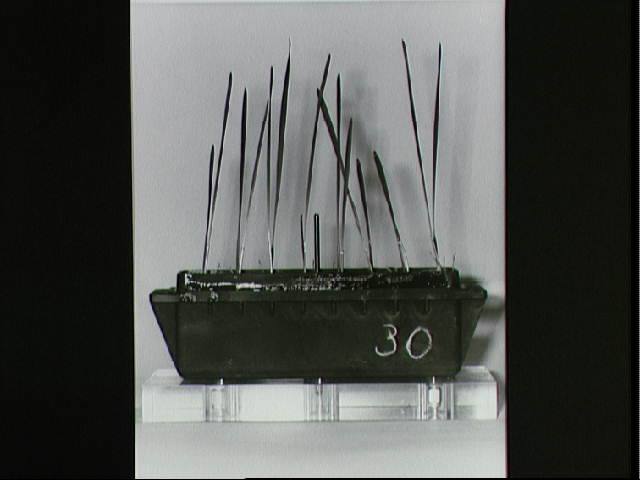
Young oat seedlings are shown in a ground laboratory after being flown into
space aboard the Space Shuttle Columbia on STS-3 in March of 1982. All
plants were part of the experimental Plant Growth Unit. They appear to have
grown to look similar to the control seedlings on earth. A few small roots
can be seen growing upward from the soil (33915); Young slash-pine
seedlings are shown upon returning from the STS-3 mission (33916); Mung
bean seedlings are shown after their return from space aboard the STS-3
Young oat seedlings are shown in a ground laboratory after being flown into
space aboard the Space Shuttle Columbia on STS-3 in March of 1982. All
plants were part of the experimental Plant Growth Unit. They appear to have
grown to look similar to the control seedlings on earth. A few small roots
can be seen growing upward from the soil (33915); Young slash-pine
seedlings are shown upon returning from the STS-3 mission (33916); Mung
bean seedlings are shown after their return from space aboard the STS-3
Young oat seedlings are shown in a ground laboratory after being flown into
space aboard the Space Shuttle Columbia on STS-3 in March of 1982. All
plants were part of the experimental Plant Growth Unit. They appear to have
grown to look similar to the control seedlings on earth. A few small roots
can be seen growing upward from the soil (33915); Young slash-pine
seedlings are shown upon returning from the STS-3 mission (33916); Mung
bean seedlings are shown after their return from space aboard the STS-3