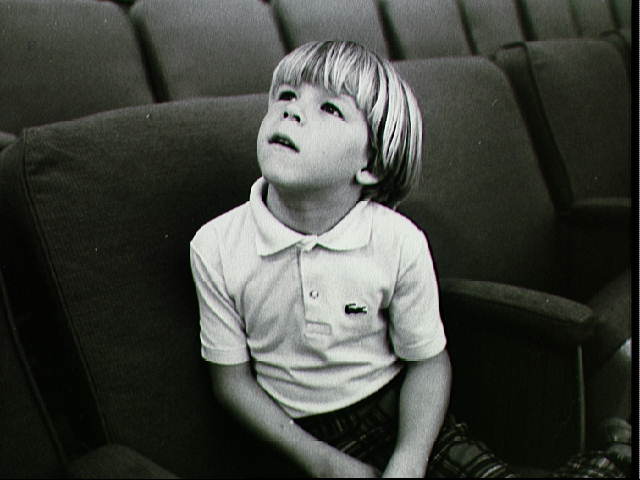
Andrew A. Fullerton, the six-year-old son of STS-3 pilot C. Gordon
Fullerton, watches a television monitor in the mission control center’s
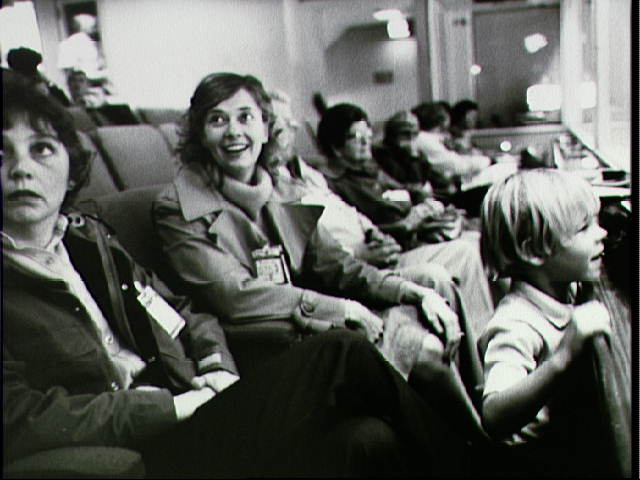
viewing room (28802); Mrs. Marie J. Fullerton in the mission control
center’s viewing room. Other members of the STS-3 pilot’s family are
seated on each side of Mrs. Fullerton. His sister, Jeanne Dockham, is at
left foreground; son Andrew A., at right foreground. Mr. and Mrs. E. G.
Buettner, Mrs. Fullerton’s parents, are seated at center, and beyond them
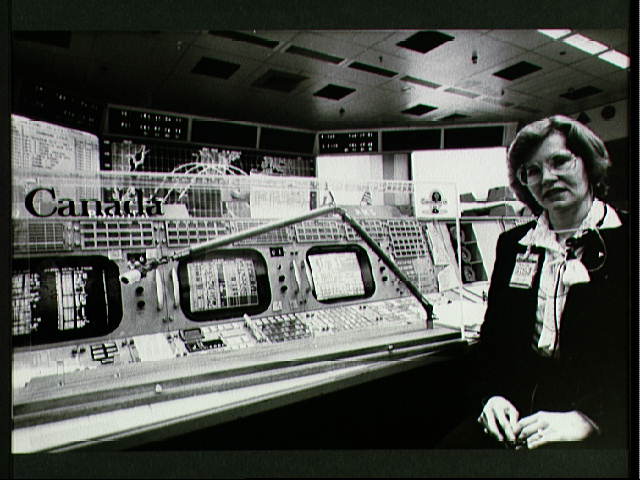
is Mrs. Charles R. Fullerton, the astronaut’s mother (28803); Mary Ann
Austin seated at the remote manipulator sytem (RMS) console in the mission
operations control room (MOCR) shares the scene with a representation of a
1/15-scale model of the Canadian-built remote manipulator system arm
(28804).
Andrew A. Fullerton, the six-year-old son of STS-3 pilot C. Gordon
Fullerton, watches a television monitor in the mission control center’s
viewing room (28802); Mrs. Marie J. Fullerton in the mission control
center’s viewing room. Other members of the STS-3 pilot’s family are
seated on each side of Mrs. Fullerton. His sister, Jeanne Dockham, is at
left foreground; son Andrew A., at right foreground. Mr. and Mrs. E. G.
Buettner, Mrs. Fullerton’s parents, are seated at center, and beyond them
is Mrs. Charles R. Fullerton, the astronaut’s mother (28803); Mary Ann
Austin seated at the remote manipulator sytem (RMS) console in the mission
operations control room (MOCR) shares the scene with a representation of a
1/15-scale model of the Canadian-built remote manipulator system arm
(28804).
Andrew A. Fullerton, the six-year-old son of STS-3 pilot C. Gordon
Fullerton, watches a television monitor in the mission control center’s
viewing room (28802); Mrs. Marie J. Fullerton in the mission control
center’s viewing room. Other members of the STS-3 pilot’s family are
seated on each side of Mrs. Fullerton. His sister, Jeanne Dockham, is at
left foreground; son Andrew A., at right foreground. Mr. and Mrs. E. G.
Buettner, Mrs. Fullerton’s parents, are seated at center, and beyond them
is Mrs. Charles R. Fullerton, the astronaut’s mother (28803); Mary Ann
Austin seated at the remote manipulator sytem (RMS) console in the mission
operations control room (MOCR) shares the scene with a representation of a
1/15-scale model of the Canadian-built remote manipulator system arm
(28804).
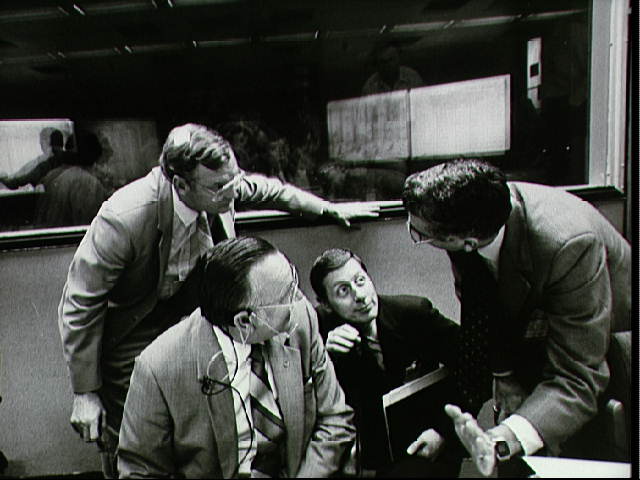
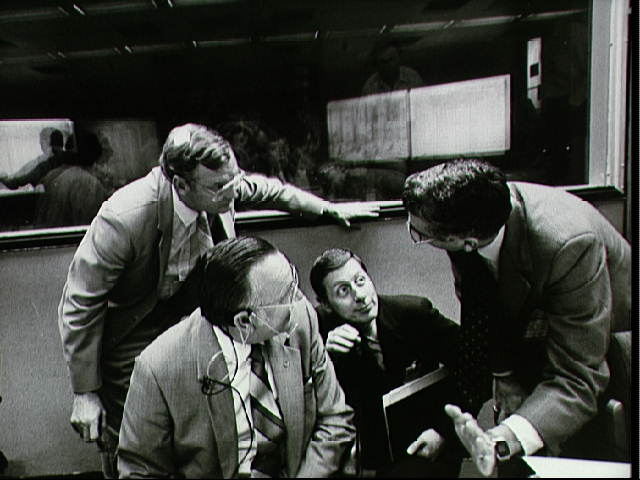
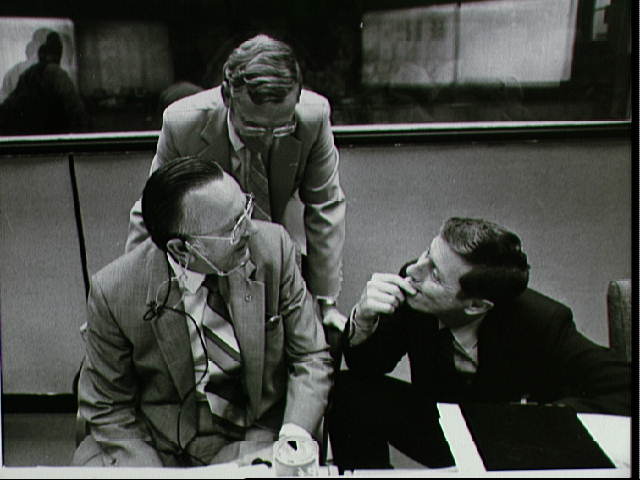
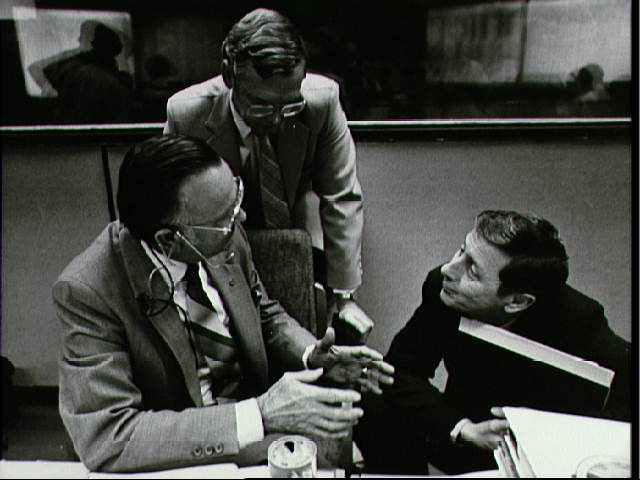
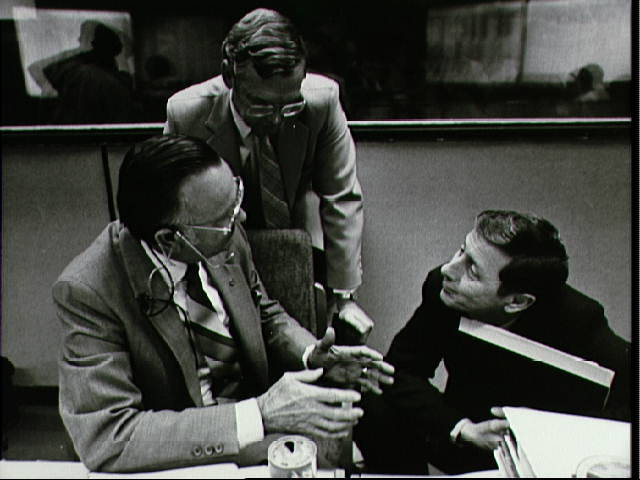
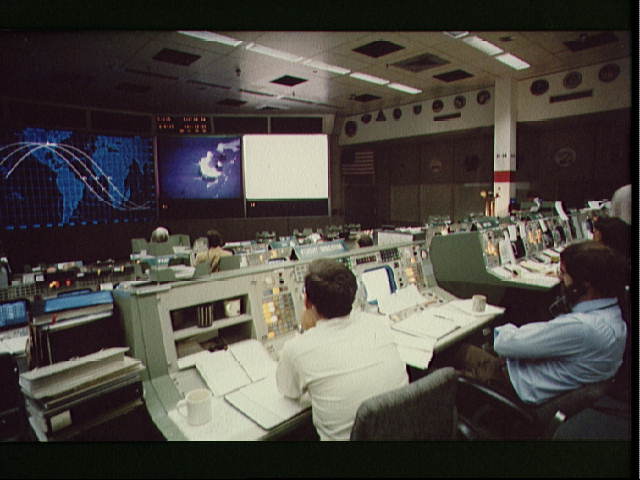
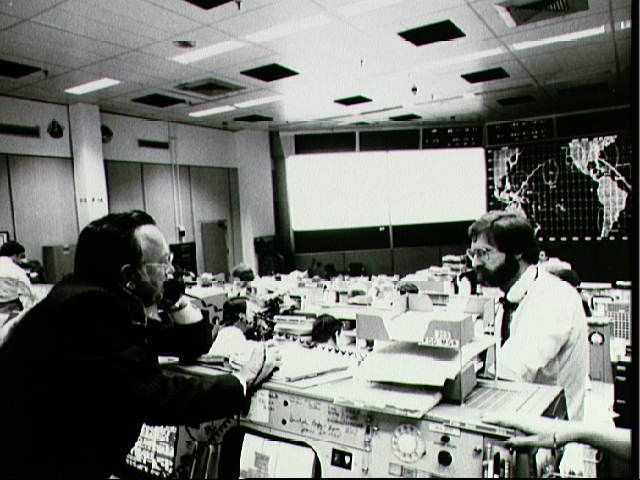
Major General J.A. Abrahamson, right, talks to JSC Director Christopher C.
Kraft, Jr., (seated left) and Space Shuttle Program Manager Glynn S. Lunney
on the back row of consoles in the mission operations control room (MOCR)
in the Johnson Space Center mission control center. The reflection behind
the men is a window for the MOCR viewing room (28772,28775); Abrahamson,
second right, talks to JSC’s Aaron Cohen, right, as Kraft (seated left)
and Lunney listen in mission control (28773); Flight controller J.E.
Connor monitors a television transmission from the Space Shuttle Columbia
during day 4 of the STS-3 mission. Conner is seated at his INCO console
(28774).
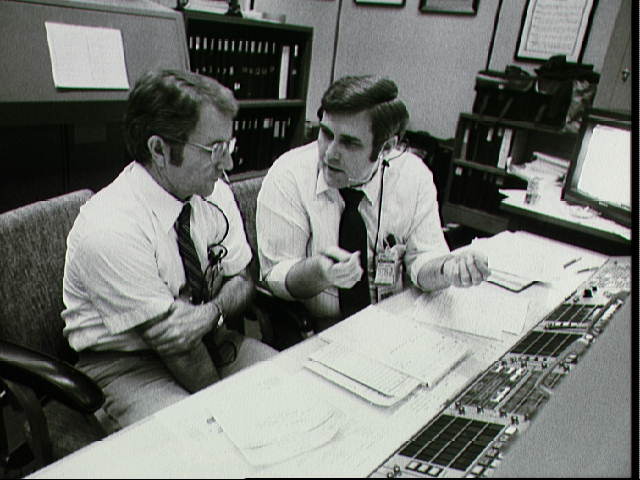
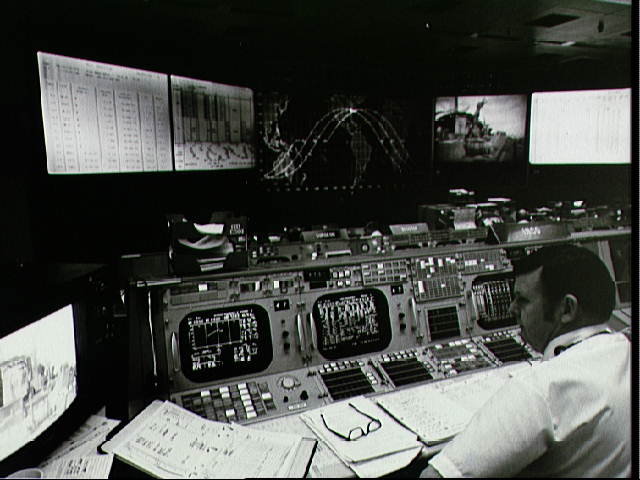
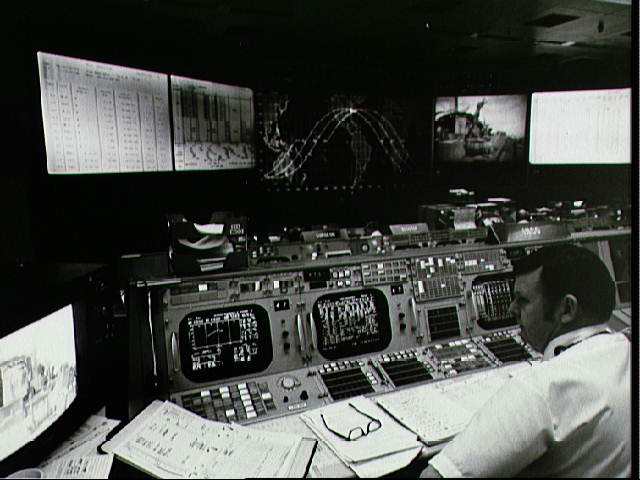
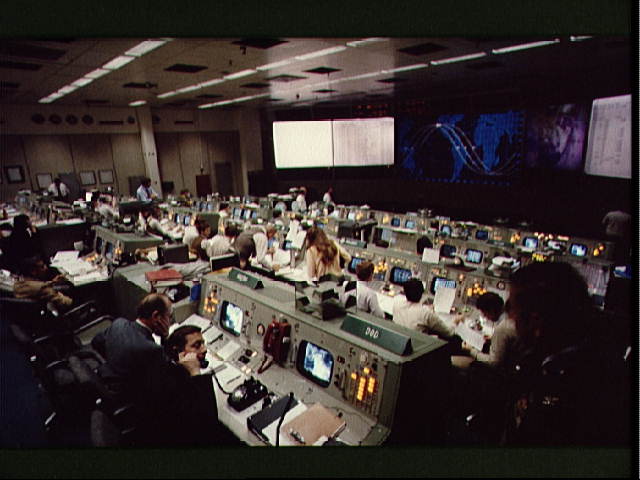
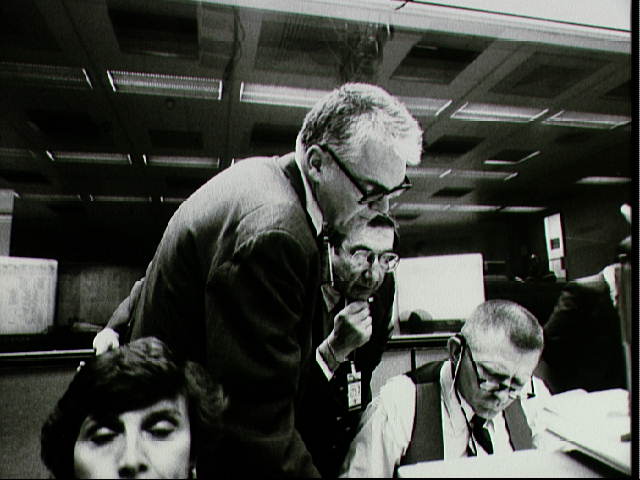
Flight controller Alan L. Briscoe reads data from the monitor at his
console in the mission operations control center (MOCR) during day 5 of
the STS-3 mission. Brisoce is at the integratred communications officer
console (28799); Astronaut Richard H. Truly and Briscoe discuss a
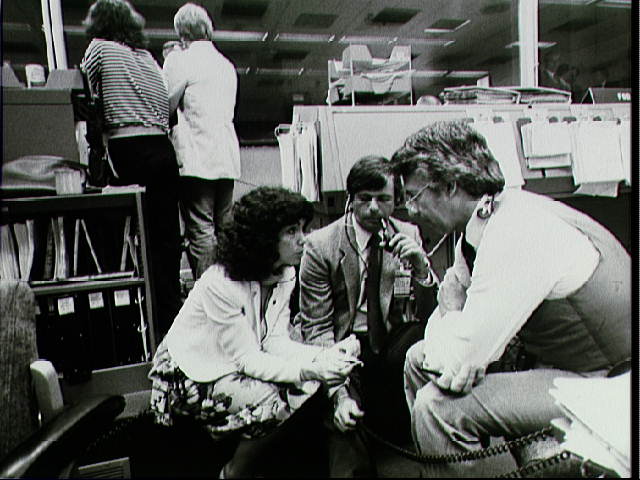
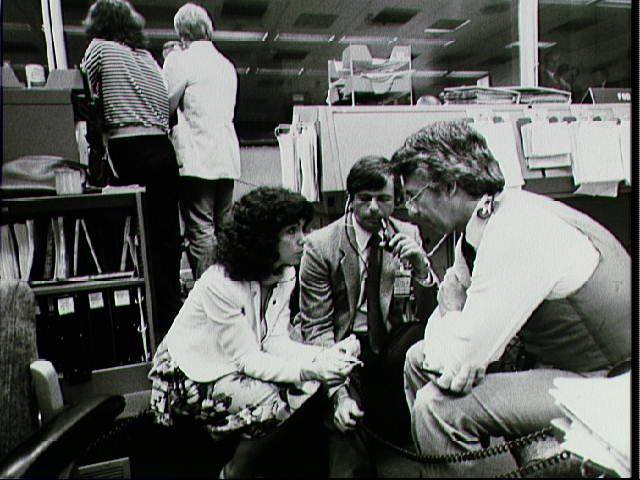
communications matter at the INCO console in the MOCR (28800); Mission
Specialist/Astronaut Judith A. Resnik confers with Flight directors Harold
M. Draughon and Jay H. Greene at their console. Another huddle at left
background includes Mission Specialist/Astronauts George D. Nelson and
Sally K. Ride (28801).
Flight controller Alan L. Briscoe reads data from the monitor at his
console in the mission operations control center (MOCR) during day 5 of
the STS-3 mission. Brisoce is at the integratred communications officer
console (28799); Astronaut Richard H. Truly and Briscoe discuss a
communications matter at the INCO console in the MOCR (28800); Mission
Specialist/Astronaut Judith A. Resnik confers with Flight directors Harold
M. Draughon and Jay H. Greene at their console. Another huddle at left
background includes Mission Specialist/Astronauts George D. Nelson and
Sally K. Ride (28801).
Flight controller Alan L. Briscoe reads data from the monitor at his
console in the mission operations control center (MOCR) during day 5 of
the STS-3 mission. Brisoce is at the integratred communications officer
console (28799); Astronaut Richard H. Truly and Briscoe discuss a
communications matter at the INCO console in the MOCR (28800); Mission
Specialist/Astronaut Judith A. Resnik confers with Flight directors Harold
M. Draughon and Jay H. Greene at their console. Another huddle at left
background includes Mission Specialist/Astronauts George D. Nelson and
Sally K. Ride (28801).
Major General J.A. Abrahamson, right, talks to JSC Director Christopher C.
Kraft, Jr., (seated left) and Space Shuttle Program Manager Glynn S. Lunney
on the back row of consoles in the mission operations control room (MOCR)
in the Johnson Space Center mission control center. The reflection behind
the men is a window for the MOCR viewing room (28772,28775); Abrahamson,
second right, talks to JSC’s Aaron Cohen, right, as Kraft (seated left)
and Lunney listen in mission control (28773); Flight controller J.E.
Connor monitors a television transmission from the Space Shuttle Columbia
during day 4 of the STS-3 mission. Conner is seated at his INCO console
(28774).
Major General J.A. Abrahamson, right, talks to JSC Director Christopher C.
Kraft, Jr., (seated left) and Space Shuttle Program Manager Glynn S. Lunney
on the back row of consoles in the mission operations control room (MOCR)
in the Johnson Space Center mission control center. The reflection behind
the men is a window for the MOCR viewing room (28772,28775); Abrahamson,
second right, talks to JSC’s Aaron Cohen, right, as Kraft (seated left)
and Lunney listen in mission control (28773); Flight controller J.E.
Connor monitors a television transmission from the Space Shuttle Columbia
during day 4 of the STS-3 mission. Conner is seated at his INCO console
(28774).
Major General J.A. Abrahamson, right, talks to JSC Director Christopher C.
Kraft, Jr., (seated left) and Space Shuttle Program Manager Glynn S. Lunney
on the back row of consoles in the mission operations control room (MOCR)
in the Johnson Space Center mission control center. The reflection behind
the men is a window for the MOCR viewing room (28772,28775); Abrahamson,
second right, talks to JSC’s Aaron Cohen, right, as Kraft (seated left)
and Lunney listen in mission control (28773); Flight controller J.E.
Connor monitors a television transmission from the Space Shuttle Columbia
during day 4 of the STS-3 mission. Conner is seated at his INCO console
(28774).
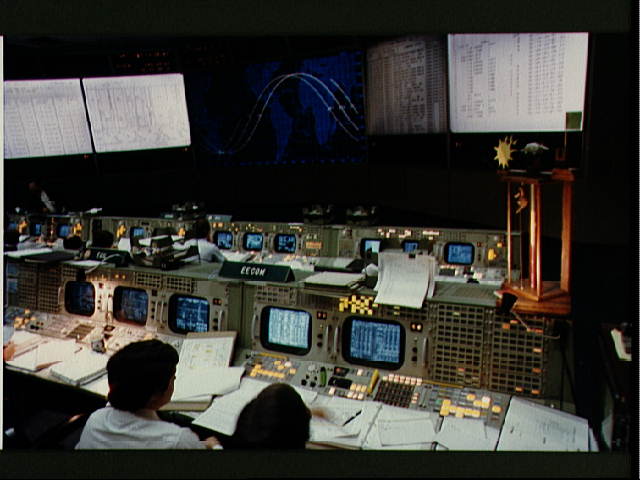
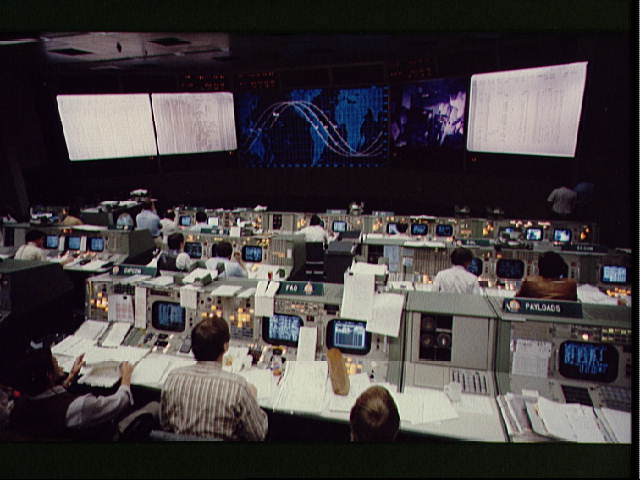
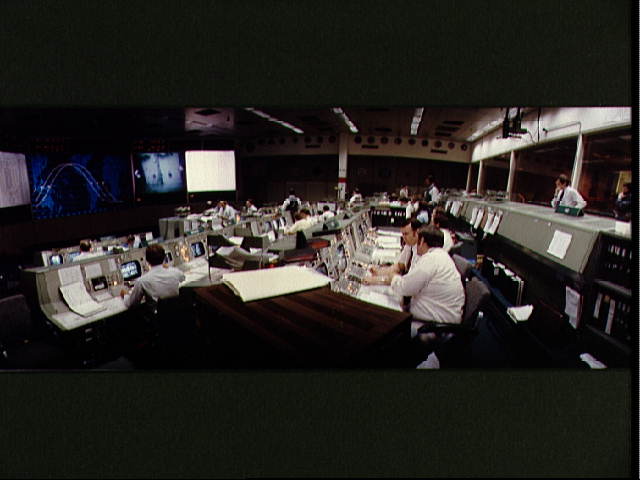
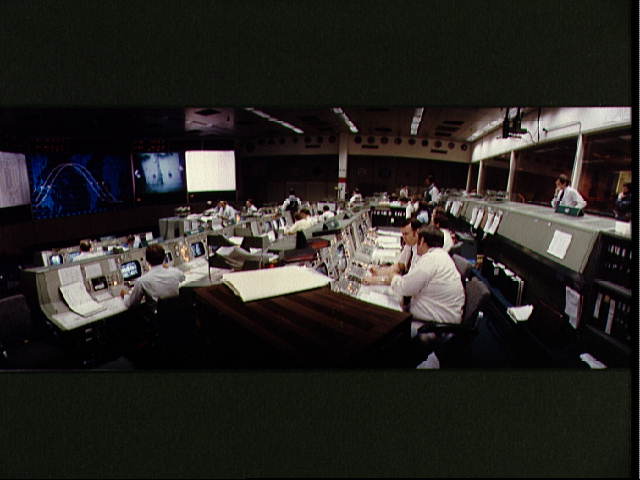
Wide angle view of Mission Operation Control Room (MOCR) activity during
Day 2 of STS-3 mission. This view shows many of th consoles, tracking map,
and Eidophor-controlled data screens. Flight controllers in the foreground
are (l.r.) R. John Rector and Chares L. Dumie. They are seated at the
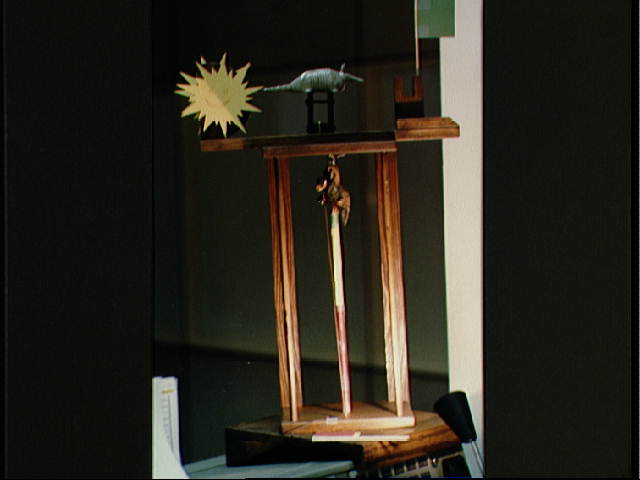
EECOM console. The “thermodillo” contraption, used by flight controllers
to indicate the Shuttle’s position in relation to the sun for various
tests, can be seen at right (28732); closeup view of the “thermodillo”.
The position of the armadillo’s tail indicates position of the orbiter in
relation to sun (28733); Mission Specialist/Astronaut Sally K. Ride, STS-3
orbit team spacecraft communicator (CAPCOM), talks to flight director
during mission control center activity. Mission Specialist/Astronaut
George D. Nelson, backup orbit team CAPCOM, watches the monitor at his
console (28734).
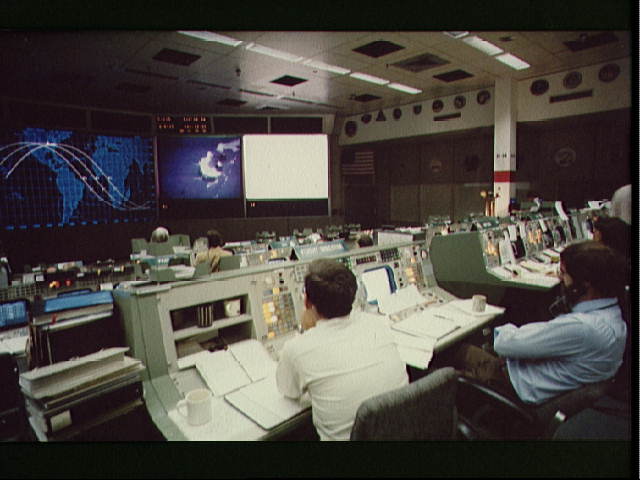
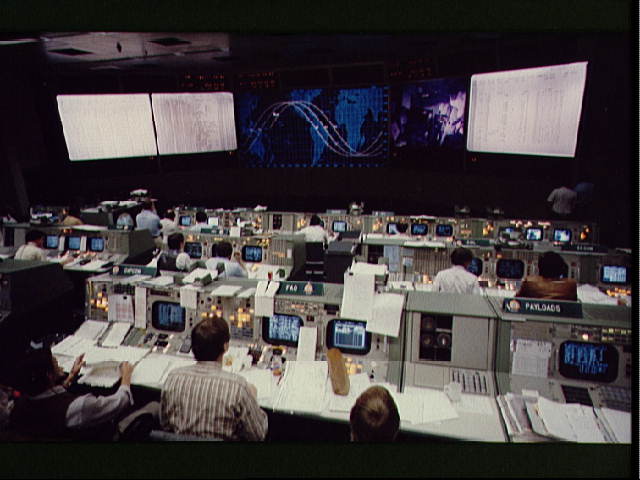
Flight director Neil B. Hutchinson (right) leans back in his chair to view
a television pass from the Columbia during the sixth day of the mission.
Note the video on the large screen left of center, revealing a closeup of
the plasma diagnostic package (PDP) in the grasp of the end effector on
the arm of the remote manipulator system (RMS). The orbiter can be tracked
by means of the map left of the panel showing video (28817); wide angle
view of the MOCR showing various consoles, and the tracking map
(28818-20).
Flight director Neil B. Hutchinson (right) leans back in his chair to view
a television pass from the Columbia during the sixth day of the mission.
Note the video on the large screen left of center, revealing a closeup of
the plasma diagnostic package (PDP) in the grasp of the end effector on
the arm of the remote manipulator system (RMS). The orbiter can be tracked
by means of the map left of the panel showing video (28817); wide angle
view of the MOCR showing various consoles, and the tracking map
(28818-20).
Flight director Neil B. Hutchinson (right) leans back in his chair to view
a television pass from the Columbia during the sixth day of the mission.
Note the video on the large screen left of center, revealing a closeup of
the plasma diagnostic package (PDP) in the grasp of the end effector on
the arm of the remote manipulator system (RMS). The orbiter can be tracked
by means of the map left of the panel showing video (28817); wide angle
view of the MOCR showing various consoles, and the tracking map
(28818-20).
Flight director Neil B. Hutchinson (right) leans back in his chair to view
a television pass from the Columbia during the sixth day of the mission.
Note the video on the large screen left of center, revealing a closeup of
the plasma diagnostic package (PDP) in the grasp of the end effector on
the arm of the remote manipulator system (RMS). The orbiter can be tracked
by means of the map left of the panel showing video (28817); wide angle
view of the MOCR showing various consoles, and the tracking map
(28818-20).
Astronauts Joe H. Engle, second right, and Richard H. Truly (standing at
left), confer with JSC flight director Christopher C. Kraft, Jr. on day 8
of the STS-3 mission. Flight director Neil B. Hutchinson is at right and
spacecraft communicators Steve R. Nagel (right) and Brewster H. Shaw, Jr.,
are at the CAPCOM console in the lower left of the frame (28831); Kraft
talks on telephone with Hutchinson. Other flight controllers can be seen
in the background (28832); Eugene F. Kranz, deputy director of flight
operations at JSC, goes over landing information with Dr. Hans Mark and
Dr. Milton Silveira, both of NASA Headquarters (28833); Engle, right, and
Truly (leaning at left center) confer with Nagel (second right) and Shaw
in the mission operations control room (28834).
Astronauts Joe H. Engle, second right, and Richard H. Truly (standing at
left), confer with JSC flight director Christopher C. Kraft, Jr. on day 8
of the STS-3 mission. Flight director Neil B. Hutchinson is at right and
spacecraft communicators Steve R. Nagel (right) and Brewster H. Shaw, Jr.,
are at the CAPCOM console in the lower left of the frame (28831); Kraft
talks on telephone with Hutchinson. Other flight controllers can be seen
in the background (28832); Eugene F. Kranz, deputy director of flight
operations at JSC, goes over landing information with Dr. Hans Mark and
Dr. Milton Silveira, both of NASA Headquarters (28833); Engle, right, and
Truly (leaning at left center) confer with Nagel (second right) and Shaw
in the mission operations control room (28834).
Astronauts Joe H. Engle, second right, and Richard H. Truly (standing at
left), confer with JSC flight director Christopher C. Kraft, Jr. on day 8
of the STS-3 mission. Flight director Neil B. Hutchinson is at right and
spacecraft communicators Steve R. Nagel (right) and Brewster H. Shaw, Jr.,
are at the CAPCOM console in the lower left of the frame (28831); Kraft
talks on telephone with Hutchinson. Other flight controllers can be seen
in the background (28832); Eugene F. Kranz, deputy director of flight
operations at JSC, goes over landing information with Dr. Hans Mark and
Dr. Milton Silveira, both of NASA Headquarters (28833); Engle, right, and
Truly (leaning at left center) confer with Nagel (second right) and Shaw
in the mission operations control room (28834).
Astronauts Joe H. Engle, second right, and Richard H. Truly (standing at
left), confer with JSC flight director Christopher C. Kraft, Jr. on day 8
of the STS-3 mission. Flight director Neil B. Hutchinson is at right and
spacecraft communicators Steve R. Nagel (right) and Brewster H. Shaw, Jr.,
are at the CAPCOM console in the lower left of the frame (28831); Kraft
talks on telephone with Hutchinson. Other flight controllers can be seen
in the background (28832); Eugene F. Kranz, deputy director of flight
operations at JSC, goes over landing information with Dr. Hans Mark and
Dr. Milton Silveira, both of NASA Headquarters (28833); Engle, right, and
Truly (leaning at left center) confer with Nagel (second right) and Shaw
in the mission operations control room (28834).
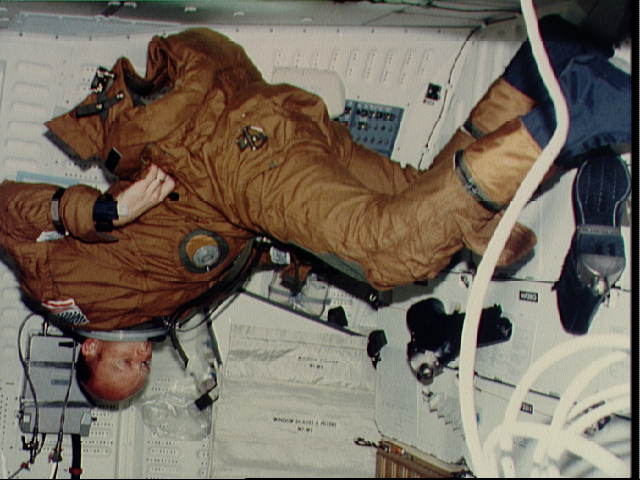
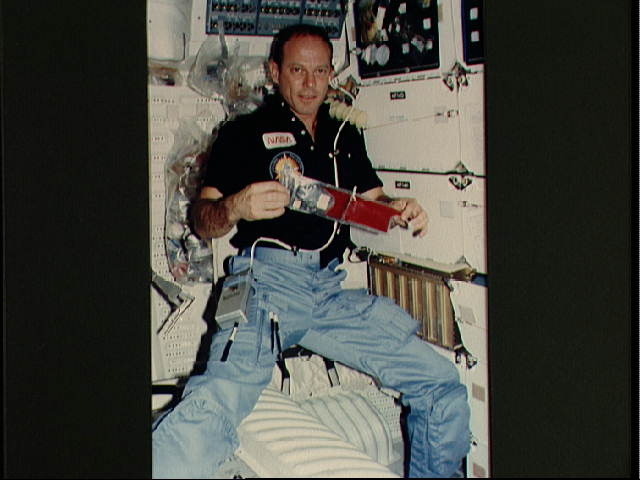
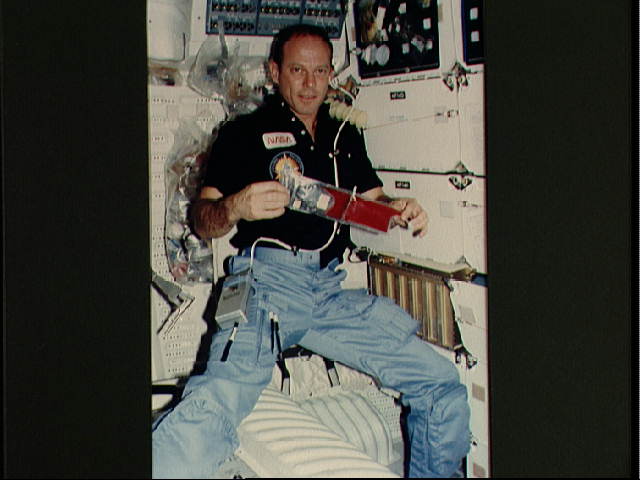
Pilot C. Gordon Fullerton dons anti-gravity (anti-g) suit lower torso, life
preserver unit (LPU) on forward port side middeck above potable water tank.
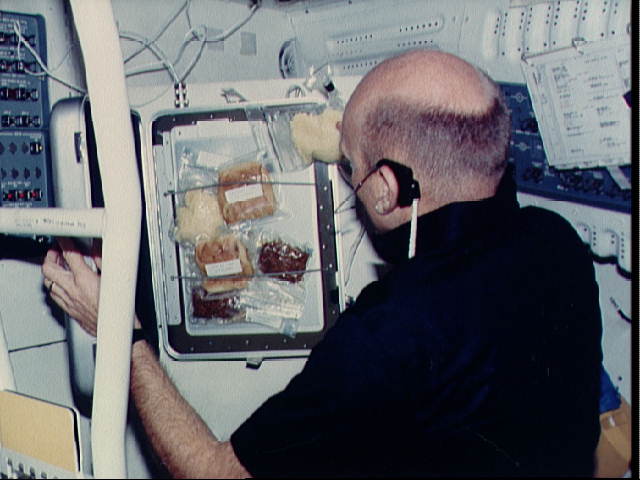
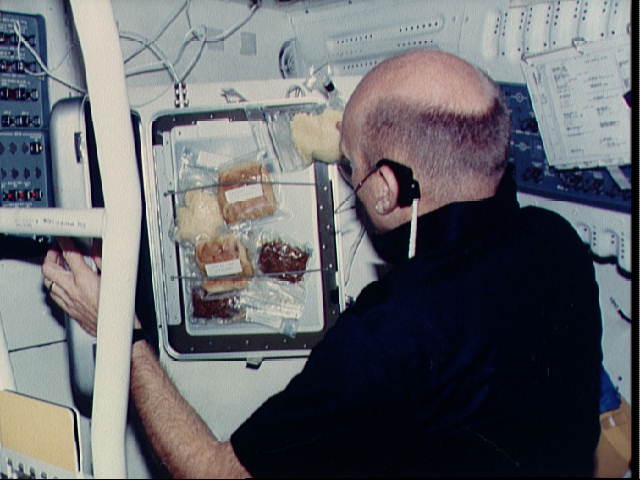
Pilot C. Gordon Fullerton, wearing communication kit assemblies (ASSY),
heats food in carry-on food warmer. Carry-on food warmer is located behind
interdeck access ladder on aft middeck and connected to panel MO13Q.
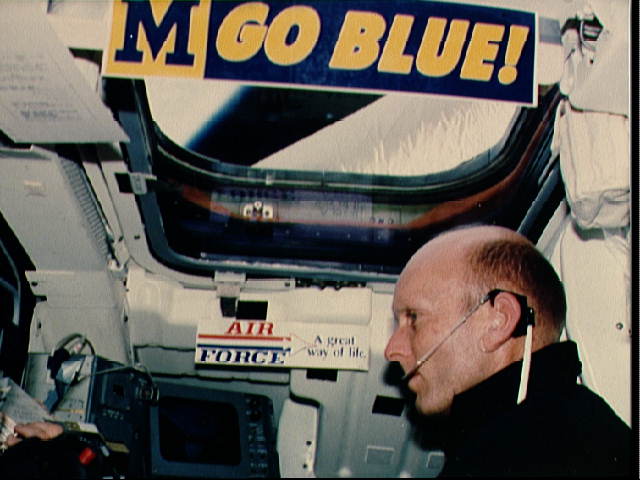
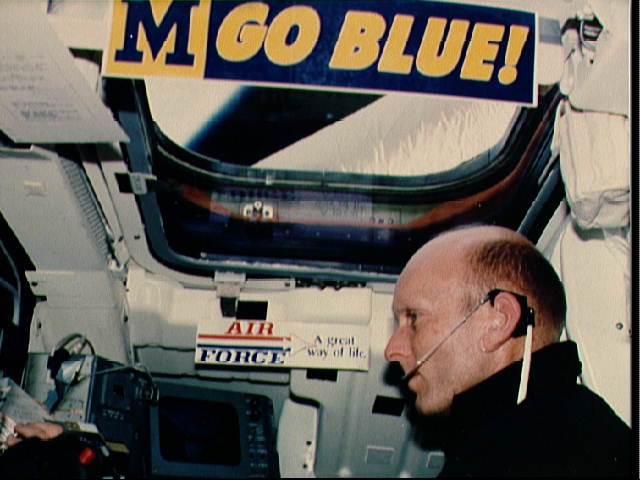
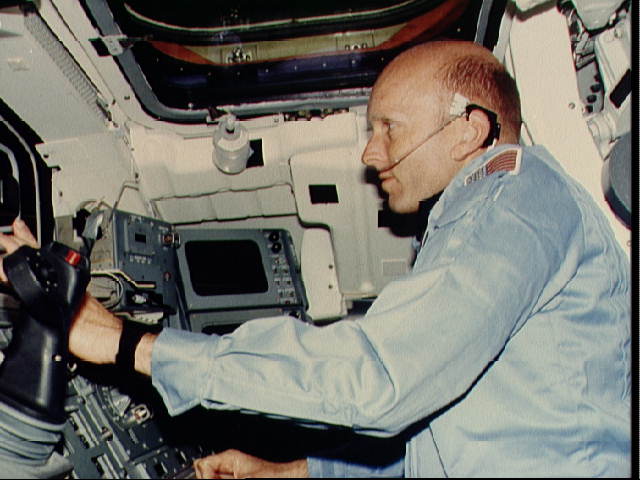
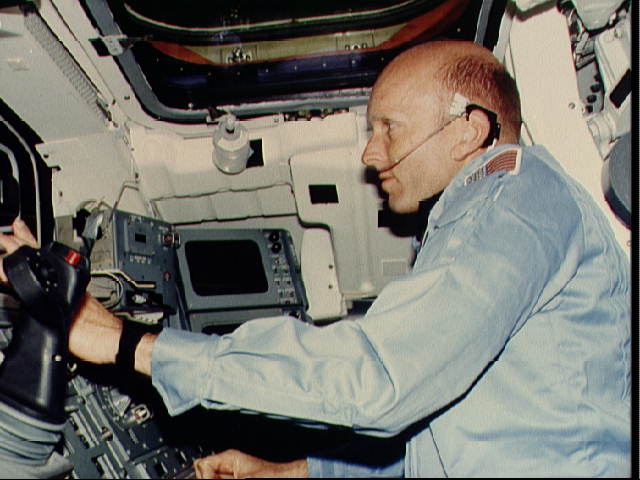
Pilot Fullerton, wearing communication kit assembly (assy) mini headset,
reviews checklist and looks at remote manipulator system (RMS) closed
circuit television (CCTV) views displayed on CCTV monitors at Aft Flight
Deck Onorbit Station. Taken from the aft flight deck starboard side,
Fullerton is seen in front of Panels A7 and A8 with remote manipulator
syste (RMS) translation hand control (THC) and RMS rotation hand control
(RHC) in the foreground and surrounded by University of Michigan (U of M)
GO BLUE and United States Air Force – A Great Way of Life Decals.
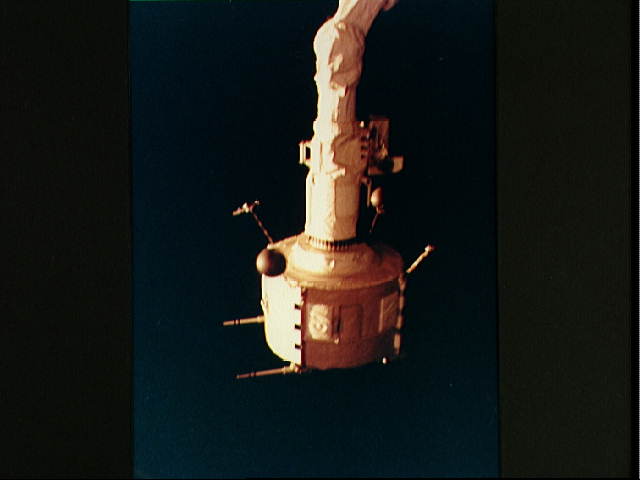
This 35mm view shows the plasma diagnostics package (PDP) photographed by
STS-3 crewmen inside the Space Shuttle Columbia in Earth orbit. The
darkness surrounding the frame indicates the outline of the ceiling window
throught which the frame was exposed. The white cylinder attached to the
experiment is the forearm of the Canadian-built remote manipulator system
(RMS). The little drum shaped package is a comprehensive assembly of
electro magnetic and particle sensors.
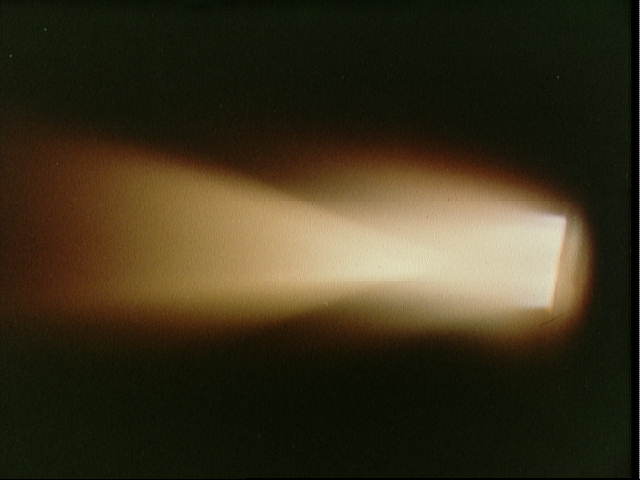
Night firing of orbiter Columbia’s thrusters.
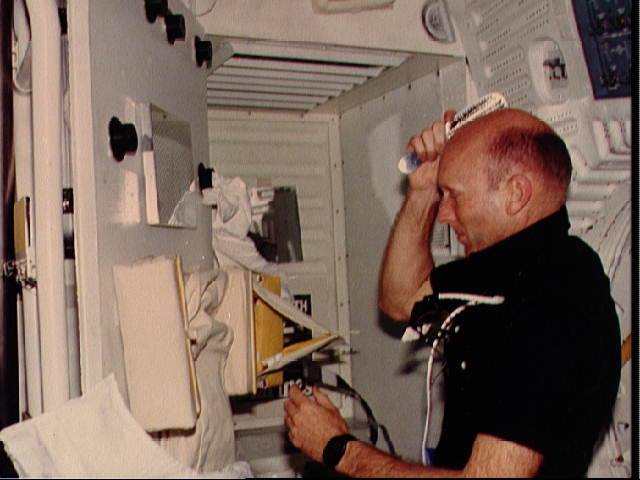
Pilot C. Gordon Fullerton uses hygiene kit hairbrush while standing in
front of the waste management compartment (WMC) door mirror on aft
middeck. Side hatch and panel ML31C appears behind him.
Commander Jack Lousma adjusts HASSELBLAD EL data camera at Electrophoresis
Equipment Verification Test (EEVT) electrophoresis unit and cryogenic
freezer stowed in crew compartment middeck aft bulkhead. View looks down
on Lousma and middeck from aft flight deck interdeck access hatch.
Commander Jack Lousma reviews Flight Data File (FDF) notebook on forward
flight deck commanders ejection seat (S1). Lousma wears the communication
kit assembly headset. Forward control panels, crewman optical alignment
sight (COAS), forward window, and 16mm camera appear in view.
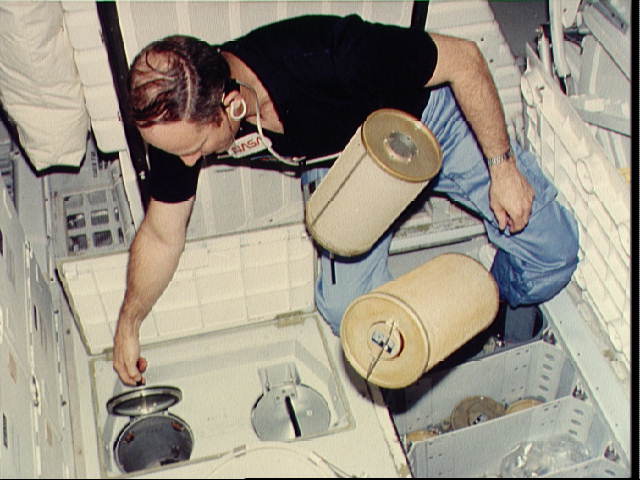
Commander Jack R. Lousma, wearing communication kit assembly (ASSY) mini
headseat (HDST), replaces air revitalization system (ARS) lithium hydroxide
(LiOH) cannisters on middeck. In front of the airlock hatch, Lousma lifts
LiOH canisters from the Carbon Dioxide (C02) Absorber Stowage volume MD52M,
removes flight wrapper, and inserts them in the LiOH canister assembly
under the ARS Servicing Panel MD54G.
Pilot C. Gordon Fullerton, wearing the communications carrier assembly
(ASSY) mini headset (HDST), beings food preparation on the middeck. Canned
goods, sealed packages, beverage containers, etc are attached with velcro
to meal tray assemblies (secured on middeck forward lockers) and freefloat
around Fullerton. JSC water dispenser kit and portrait of G.W.S. Abbey
appears behind Fullerton on port side bulkhead and potable water tank
appears below him.
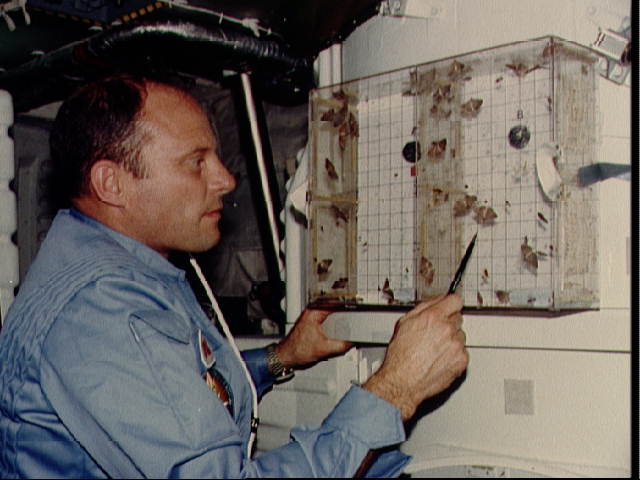
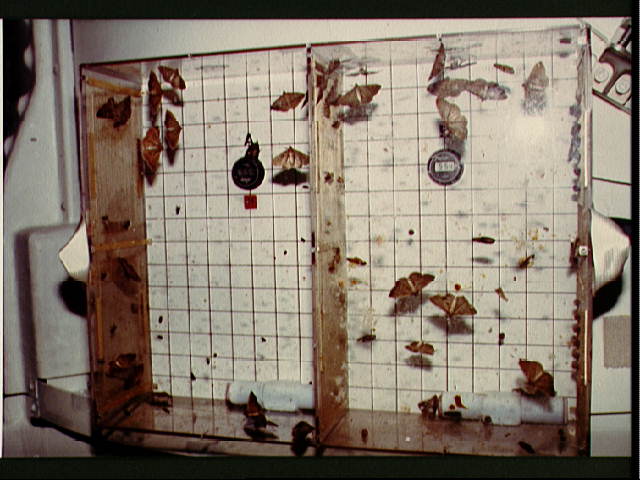
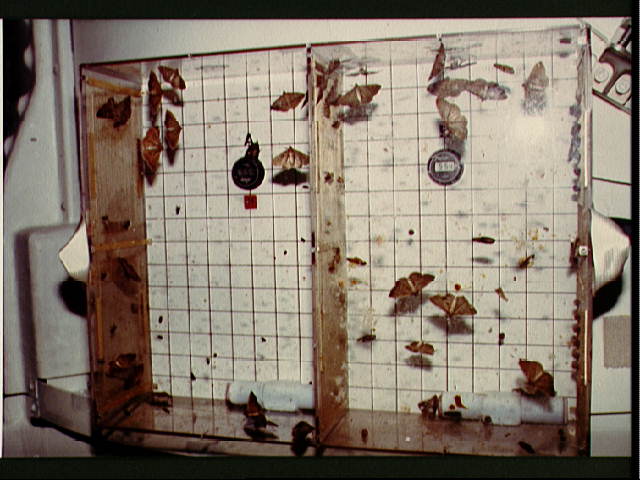
Commander Jack Lousma examines Insect Flight Motion Study (Student
Experiment) taped to the airlock on the aft middeck. Lousma points to
velvetbean caterpillar moth activity with a pen.
Commander Jack Lousma wearing the communications kit assembly (ASSY) mini
headsets (HDSTs), conducts Bubble Separation Experiment on the middeck.
Lousma displays experiment in front of the port side forward middeck
lockers (meal tray assemblies secured on lockers).
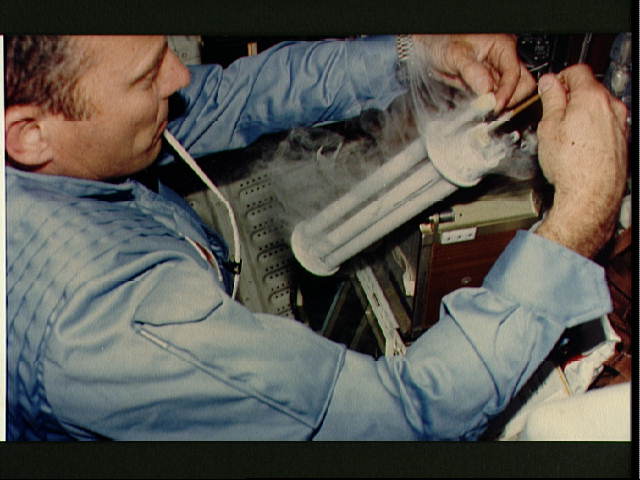
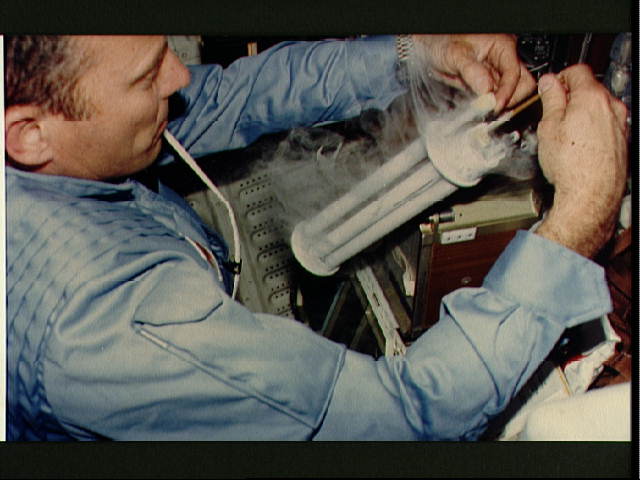
Commander Jack Lousma prepares on of the glass columns for the
electrophoresis test in the middeck area of the Columbia. The experiment,
deployed in an L-shaped mode in upper right corner, consists of the
processing unit with glass columns in which the separation takes place; a
camera (partially obscurred by Lousma’s face) to document the process; and
a cryogenic freezer to freeze and store the samples after separation.
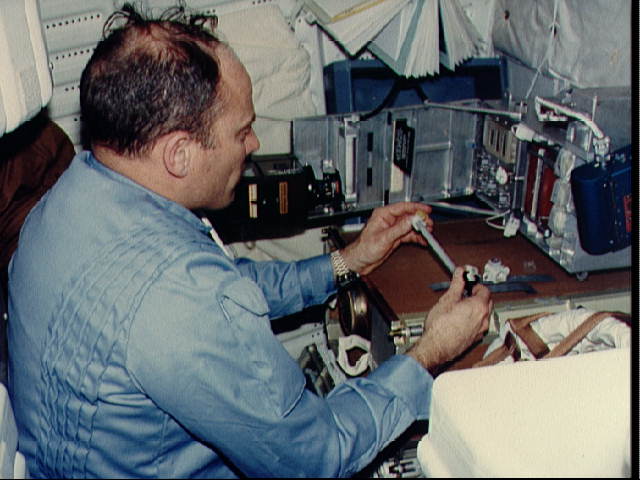
Commander Jack Lousma works with Electrophoresis Equipment Verification
Test (EEVT) electrophoresis unit, cryogenic freezer and tube, and stowage
locker equipment located on crew compartment middeck aft bulkhead.
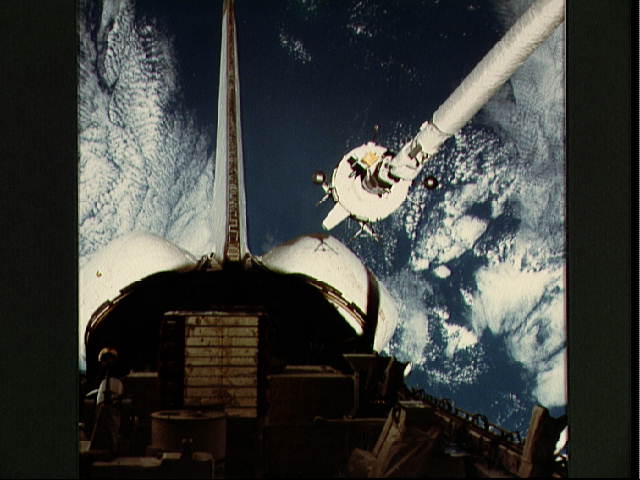
Morocco’s Atlantic coast is backdrop for view of the Columbia’s aft
section. The long remote manipulator system (RMS) is in a resting posture
(lower right corner) stretched out along the 60-ft. long cargo bay. Many
of the components of the OSS-1 payload package are in the bottom center,
such as the Thermal Canister experiment (the box on the left side of the
bay) and the Solar Flare X-Ray Polarimeter Experiment (round object below
the Thermal Canister experiment). The mounds on either side of the tail
are the pods for the orbital maneuvering system (OMS).
This view shows the plasma diagnostics package (PDP) photographed by STS-3
crewmen in the grasp of the end effector of the remote manipulator system
(RMS) and other components of the OSS-1 package in the aft section of the
Columbia’s cargo hold. Other OSS-1 payload experiments seen in the bay
include the Thermal Canister Experiment, the Solar Flare X-Ray Polarimeter
Experiment, the Vehicle Charging and Potential Experiment and the Induced
Atmosphere Experiment.
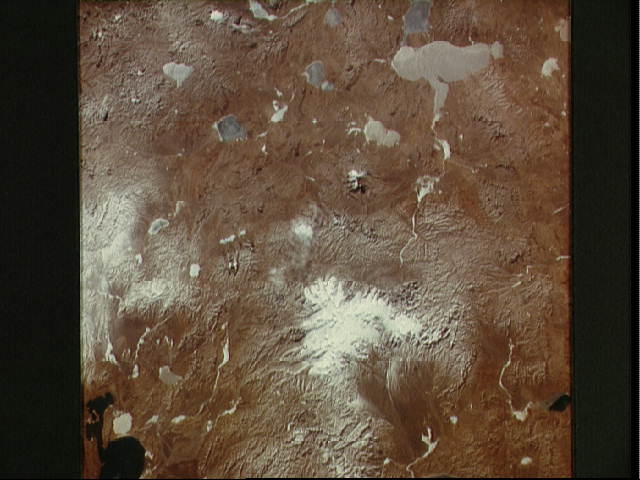
Pristine lakes in the high Tibeten plateau, (34.0N, 89.5E) one of the most
remote regions of the world, are still partially frozen in this early
spring photo. The lakes are almost the only source of water to support
life in this harsh region and have been formed as a result of the Indian
sub continent’s incursion into the Asian continent, raising the water
table and forming these many lakes in an otherwise barren landscape.
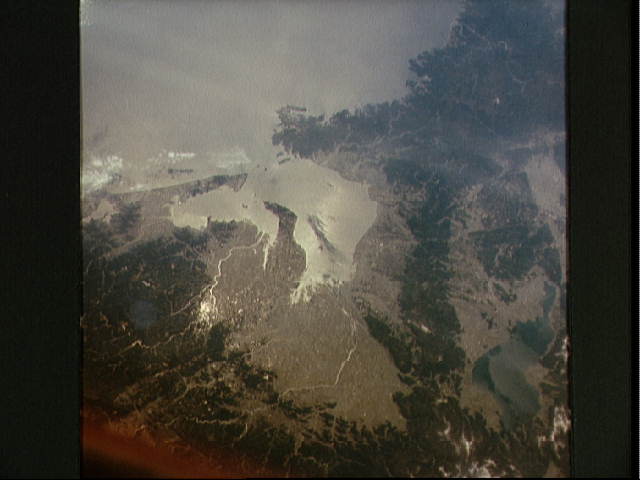
This view of Nagoya, Ise Bay and nearby Kyoto, on the main island of
Honshu, Japan (35.0N, 137.0E) combines in a single photo both the
political, cultural and educational centers of early Japan as well as one
of the main educational and business centers of modern Japan. Besides
being a business, cultural and educational center, Nagoya is near the
geographic center of the Japanese home islands.
This southerly looking view photographed from the orbiting Space Shuttle
Columbia shows a small portion of the vehichle’s aft section. The 50-ft
Canadian built remote manipulator system (RMS) is in a resting posture
(lower right corner) stretched out along the 60-ft. long cargo bay. Many
of the components of the OSS-1 payload package are in the bottom center.
The Mediterranean Sea is at right foreground. Parts of the Sinai
peninsula, Israel, Egypt, Saudi Arabia, Jordan, Palestine, Syria, and
Lebanon can be located in the photo. The Red Sea, Gulf of Aqaba, Suez
Canal are near the photo’s horizon.
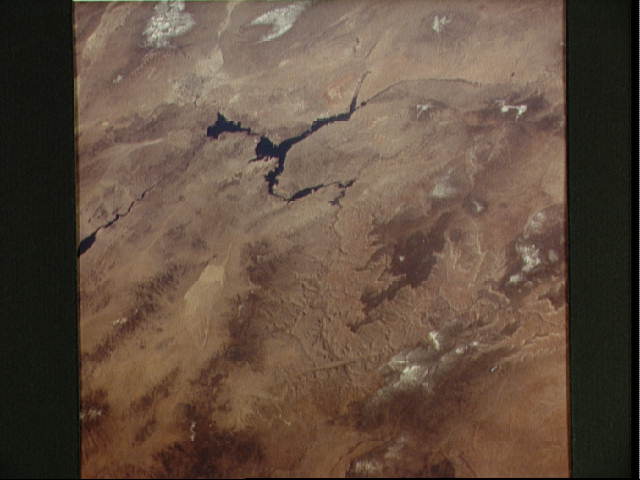
Lake Mead, Nevada, (36.0N, 114.5E) where the water from the Colorado River
empties after it’s 273 mile journey through the Grand Canyon of Arizona is
the subject of this photo. Other features of interest are Hoover Dam on
the south shore of Lake Mead where cheap hydroelectric power is secondary
to the water resources made available in this northern desert region and
the resort city of Las Vegas, just to the west of Lake Mead.
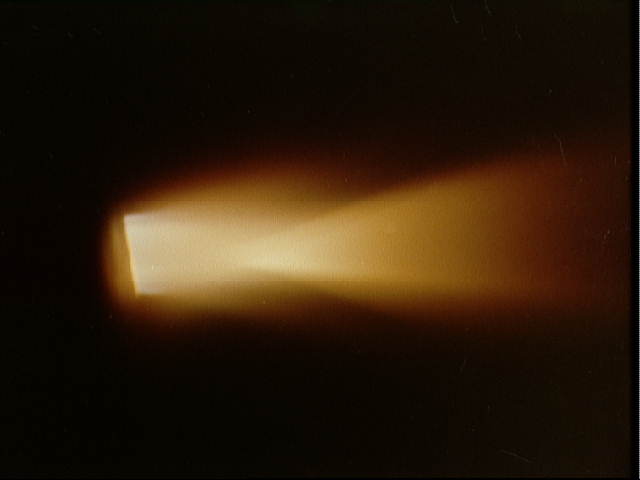
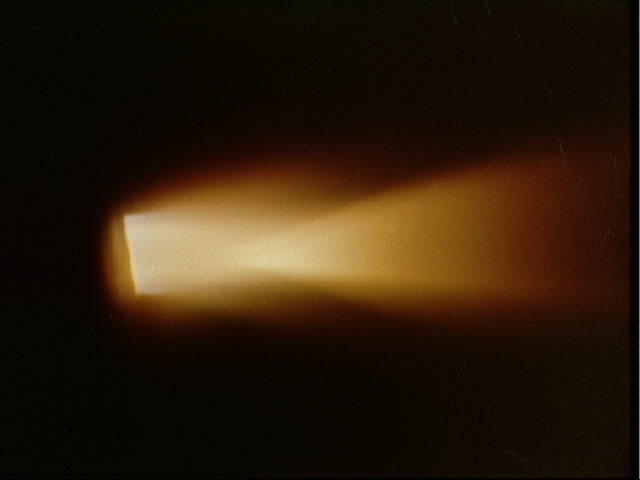
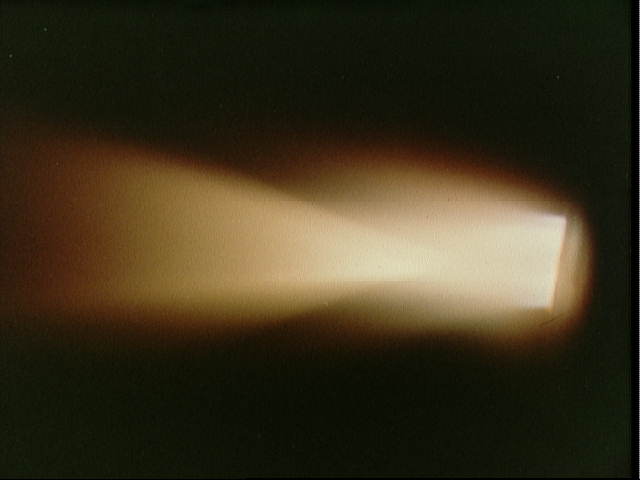
A momentary blast from one of the three Forward Reaction Control rocket
engines is captured on film in this unique photograph. By selectively
firing the rocket thrusters, located at various places around the vehicle
fusalage, the space shuttle can be maneuvered in orbit beyond the Earth’s
atmosphere where the traditional aircraft flight control devices, used in
landing, have no effect.
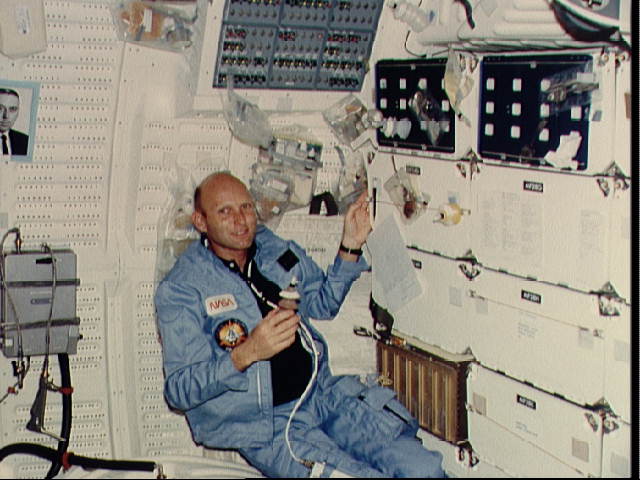
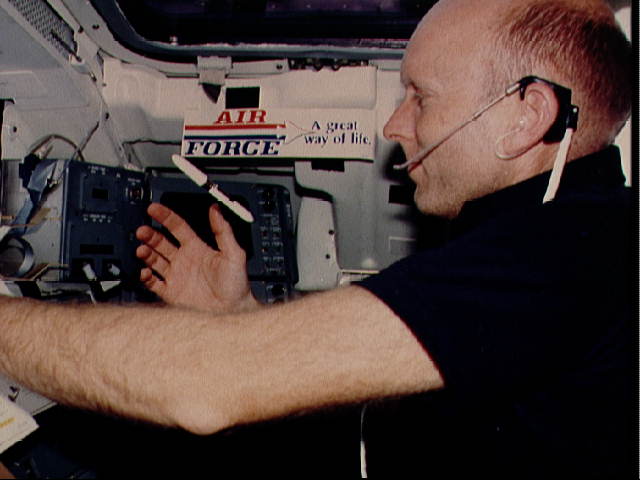
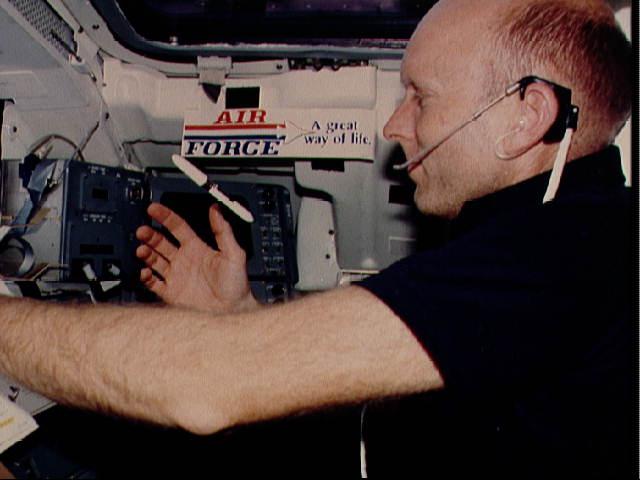
Pilot Gordon Fullerton, wearing communications kit assembly (assy) mini
headset, watches freefloating pen during checklist procedures at Aft Flight
Deck Onorbit Station. Taken from the aft flight deck starboard side,
Fullerton is seen in front of panels A7 and A8 with W8 and a “United States
Air Force – a Great Way of Life” decal overhead.
Commander Jack Lousma works with Electrophoresis Equipment Verification
Test (EEVT) electrophoresis unit, cryogenic freezer, and stowage locker
equipment located in crew compartment middeck aft bulkhead. View looks
down on Lousma and middeck from aft flight deck interdeck access hatch.
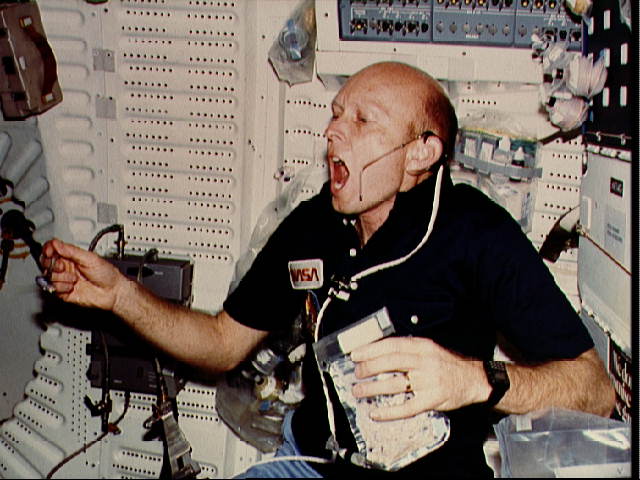
Pilot Fullerton, wearing communications kit assembly (assy) mini headset
(HDST) and with mouth open, awaits the arrival of a free-floating spoonful
of food. Fullerton holds the rehydrated plastic food package in his left
hand. The JSC water dispenser kit and the side hatch are visible on the
port side wall behind Fullerton. A meal tray assembly with additional
food items and beverages is attached to forward middeck lockers just above
Fullerton’s head.
Student Experiment 81-8 (SE-81-8) Insect Flight Motion Study taped to the
airlock on aft middeck.
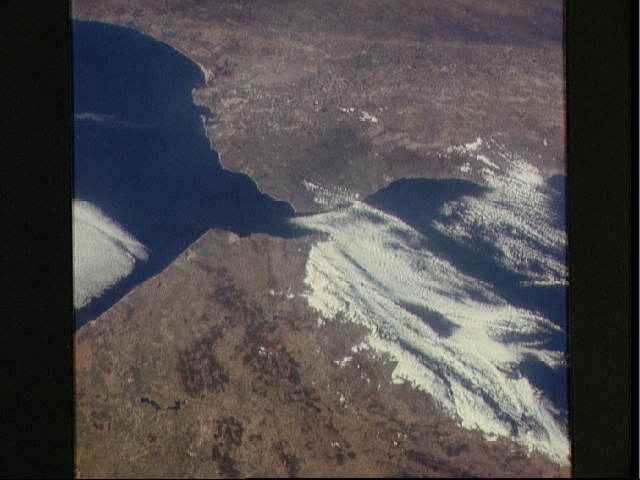
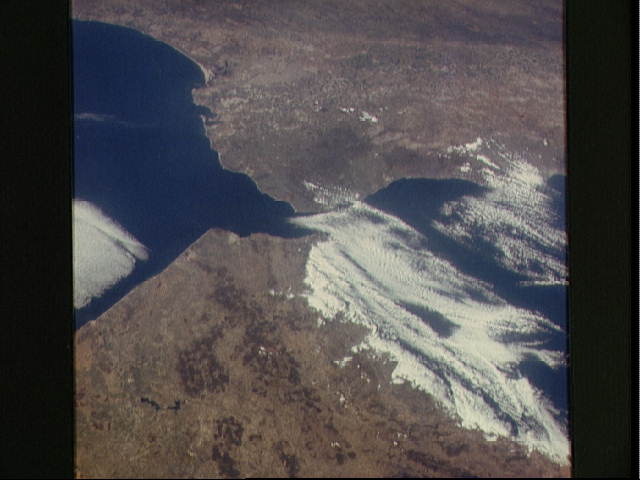
The Strait of Gibraltar as seen from the south (36.0N, 5.5W). This scene
shows the actual Rock of Gibraltar under cloud cover but most of the Strait
of Gibraltar, at the mouth of the Mediterranaen Sea and the Atlantic Ocean,
can be seen in good detail. Despite the obliquity of the scene, much of
the beauty of the Spanish and Moroccan countryside can still be
appreciated.
Plasma Diagnostics Package (PDP) grappled by remote manipulator system
(RMS) end effector is positioned above payload bay (PLB) at sunrise.
Commander Lousma, wearing communications kit assembly (ASSY) mini headset
(HDST), records Plant Growth Unit (PGU) data for the Influence of
Weightlessness on Plant Lignification Experiment at forward middeck locker
MF14K. The experiment is designed to demonstrate the effect of
weightlessness on the quantity and rate of lignin formation in different
plant species during early stages of development. Port side bulkhead with
window shade and filter kit appears behind Lousma and potable water tank
below him. Trash bag also appears in view.
Pilot Fullerton, wearing communication kit assembly (assy) mini headset
(HDST), sleeps on aft flight deck resting his back against the floor and
his feet against Commanders ejection seat (S1) seat back. Onorbit Station
control panel A8 and Payload Station panel L15 appear above Fullerton.
Special clips for holding notebooks open and beverage containers are
velcroed on various panels.
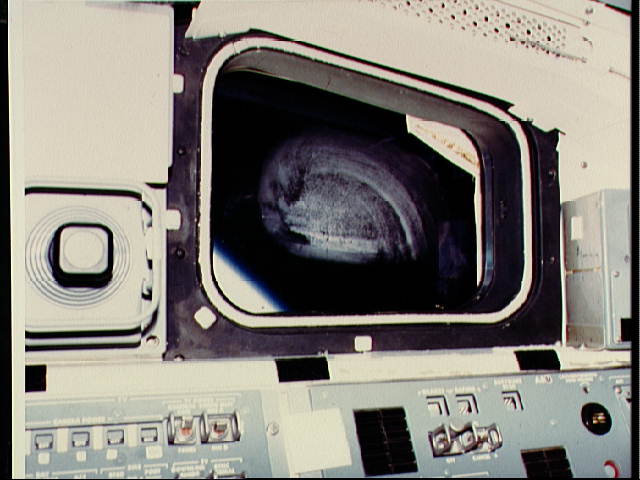
Crew compartment aft flight deck viewing window W10 fogged with
condensation. The condensation is a result of the spacecraft’s position in
relation to the sun.
A panaramic view of eastern Egypt, The Red Sea and Saudi Arabia beyond
(24.0N, 33.0E). In this desert country, where water is life, the high
Aswan Dam and the impounded waters of the Nile River in the foreground
assure water availability into the next century. The Red Sea beyond, part
of the Suez Canal seaway, serves as a commercial link to the world and
separates Egypt from Saudi Arabia.
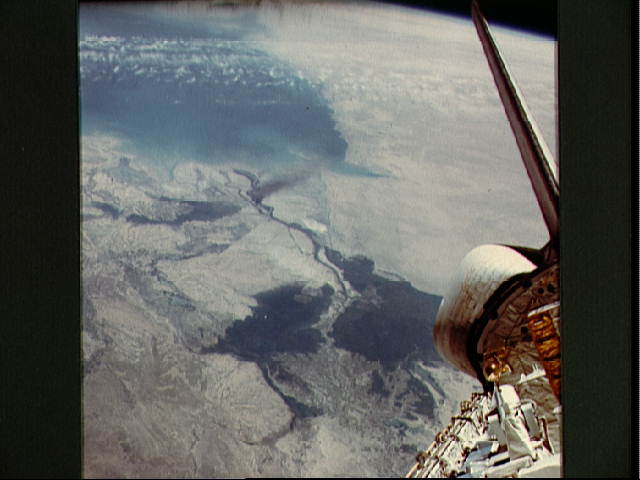
The southern part of Iraq (30.0N, 48.0E) at the Hawr al Hammar lakes and
marshlands where the mouths of the Tigris and Euphrates Rivers enter the
northern Persian Gulf and serve as a border between Iraq and Iran seen at
the left. The neighboring oil rich countries of Kuwait and Saudi Arabia
are at the headwaters of the Gulf and extend into the background.
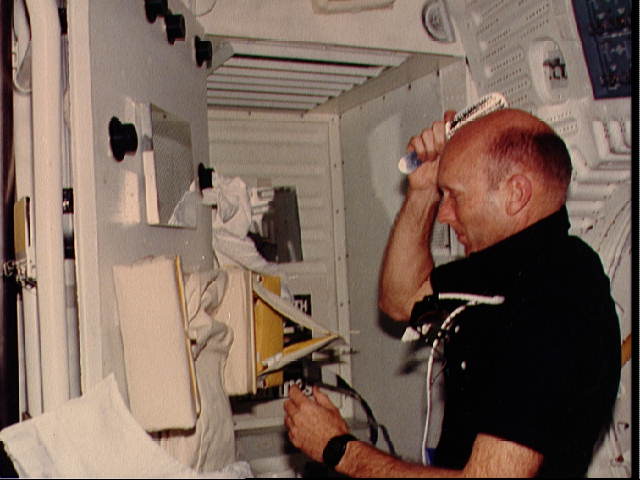
Pilot Fullerton, wearing communications kit assembly (ASSY) mini headset
(HDST), uses hygiene kit hair brush on aft middeck. He makes light of his
lack of hair during a freshening up session. He makes a token effort with
a hair brush. Side hatch and panel ML31C appear behind him.
Commander Lousma, wearing communications kit assembly (ASSY) mini headset
(HDST), adjusts controls on MonodisperseLatex Reactor (MLR) experiment
located in forward middeck lockers MF57H and MF57K. To reach MLR support
electronics assy controls, Lousma squeezes in between forward lockers and
Development Flight Instrument (DFI) unit on starboard bulkhead.
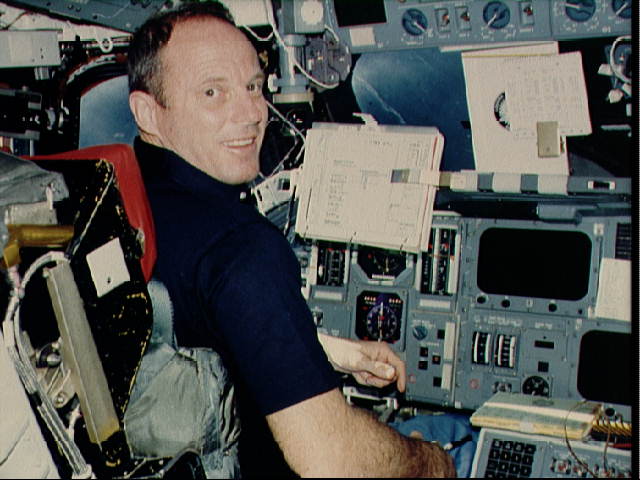
Pilot Fullerton, wearing communications kit assembly (ASSY) mini headset
(HDST), reviews flight data file (FDF) checklist and text and graphics
system (TAGS) printout (ticker tape) while in pilots ejection seat (S2).
Pilot Station control panels F4, F7, F8, O3, window shade, and portable
oxygen system (POS) assy appear in view.
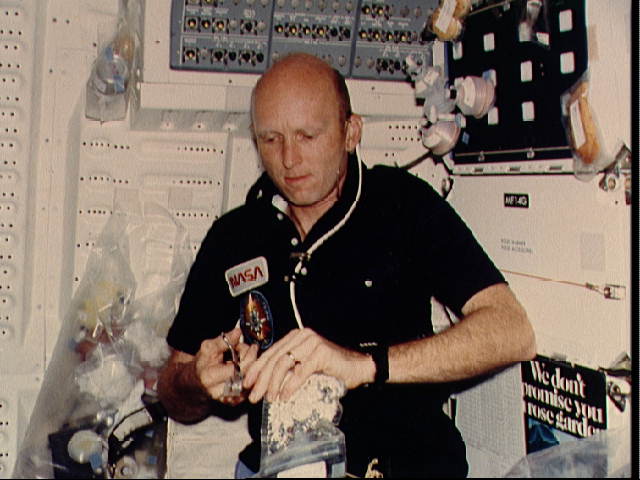
Pilot Fullerton, wearing communications kit assembly (assy) mini headset
(HDST), prepares meal on middeck. Fullerton clips corner of rehydratable
food (cereal) package with scissors. The opening will allow Fullerton to
insert JSC water dispenser kit water gun in order to heat contents with hot
water. Meal tray assembly is secured to forward middeck locker and holds
additional food packages and beverage containers.