All systems are “GO” for tomorrow’s scheduled launch of a United Launch Alliance Atlas V rocket carrying the second Space Based Infrared System geosynchronous satellite, known as SBIRS GEO-2, for the United States Air Force. With the weather forecast to have a 70% probability of favorable conditions, liftoff is targeted to occur at the beginning of a 40-minute launch window that opens at 5:21 p.m. EDT.
SBIRS GEO-2 Mission Book
SBIRS System Brochure
SBIRS GEO Fact Sheet
SBIRS HEO Fact Sheet
SBIRS GEO-2 will be lofted into a classified orbit 22,300 miles high following its launch on the 37th Atlas V rocket from Space Launch Complex 41 at Cape Canaveral Air Force Station in Florida. From its vantage point in geosynchronous orbit, the spacecraft will provide the U.S. military with an additional suite of sensors to detect potentially threatening missile launches around the world. The Space Based Infrared System is considered one of the nation’s highest priority space programs and is designed to provide global, persistent, infrared surveillance capabilities for missile warning and defense, battlespace awareness and technical intelligence.
The SBIRS program is the follow-on capability to the highly successful Defense Support Program. The system has provided vital early warning notification of long-range missile launches for more than 30 years. The upgraded capabilities of SBIRS provide greater flexibility and sensitivity and can detect short-wave and expanded mid-wave infrared signals allowing the system to perform a broader set of missions.
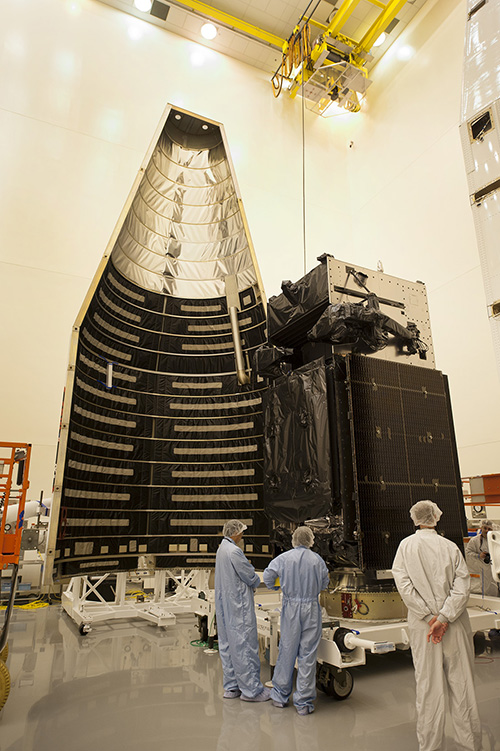
Featuring a mix of satellites in geosynchronous orbit, hosted payloads in highly elliptical earth (HEO) orbit, and ground hardware and software, the SBIRS program delivers resilient and improved missile warning capabilities for the nation while also providing significant contributions to the military’s missile defense, technical intelligence and battlespace awareness mission areas.
The SBIRS GEO spacecraft are manufactured by prime contractor Lockheed Martin on a 3-axis stabilized platform with a scanning sensor and a staring sensor. Sensor pointing is accomplished with mirrors inside the telescopes. The scanning sensor provides a shorter revisit time than older DSP sensors over its full field of view.
The GEO staring sensor has high agility to rapidly stare at one earth location and then move to other locations, with improved sensitivity compared to DSP. Several areas can be monitored by the staring sensor with revisit times significantly smaller than that of DSP.
“We understand the important role SBIRS plays in our national security architecture and the entire SBIRS team has worked tirelessly to prepare this satellite for a successful launch,” said Jeff Smith, Lockheed Martin’s vice president of Overhead Persistent Infrared (OPIR) mission area. “The dedication and talent of this SBIRS team is remarkable and we are keenly focused on delivering mission success for the warfigher.”
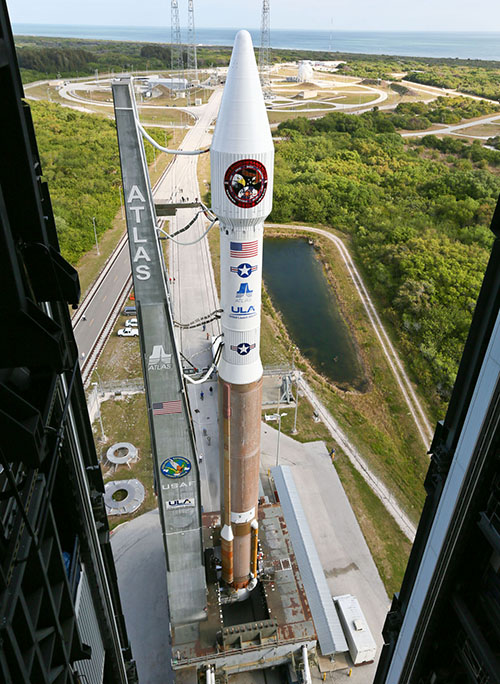
The SBIRS mission will utilize the Atlas V 401 variant of the launch vehicle. In this configuration, the rocket consists of a single Atlas V liquid-fuel boostger stage, a Centaur upper stage and a 4-m diameter payload fairing (PLF).
The Atlas V booster is 12.5 ft in diameter and 106.5 ft long with propulsion provided by the Russian-developed RD-180 engine system which has a single engine with two thrust chambers and nozzles. The RD-180 burns RP-1, a rocket-grade highly refined keosene, and liquid oxygen. The first stage generates 860,200 pounds of thrust at sea level.
Primary control of the Atlas V booster comes from the second stage the Centaur avionics system which provides guidance, flight control, and vehicle sequencing functions during both the booster and Centaur phases of flight.
The Atlas V second stage takes over powered flight after the boost phase of the first stage has completed and separation of the stages has occurred. The venerable Centaur upper stage is powered by a single RL10A-4-2 cryogenic engine. Centaur has been used in the Atlas vehicle family since the early 1960’s and is one of the most reliable and utilized upper stage engines in production today.
The Centaur has a diameter of 10 feet and is 41.5 ft long. Centaur is powered by liquid hydrogen and liquid oxygen, the most powerful combination of chemical propellants in use today. The RL10A-4-2 produces 22,300 pounds of thrust and carries the payload for the remainder of powered flight. The tanks are insulated with a combination of helium purged insulation blankets, radiation shields, and spray-on foam insulation. The Centaur forward adapter provides the structural mountings for the fault-tolerant avionics system and the structural and electronic interfaces with the spacecraft.
A 14-foot diameter payload fairing tops the Atlas, encapsulating SBIRS GEO-2 during its ascent through the lower atmosphere. Overall, the vehicle’s height is approximately 189 ft.
The mission begins with ignition of the RD-180 engine approximately 2.7 seconds prior to liftoff. Once the engine has reached full thrust and checks confirm that all systems are performing nominally, the rocket is cleared for liftoff and the hold-down clamps that secure the rocket to the mobile launch platform are released.
First motion occurs at T+1.1 seconds. Shortly after the vehicle clears the pad, it performs pitch, yaw and roll maneuvers to place the rocket on the proper launch azimuth and ensure its antennae and other systems are oriented properly in reference to ground and orbiting tracking stations.
As the rocket reaches Max-Q, the time of maximum aerodynamic pressure, the stresses on the vehicle will be at their greatest during launch. After passing this region and going supersonic, the RD-180 will be throttled down to 95% of full rated thrust. The rocket’s gravity turn will give way to active guidance steering at about 1 minute and 20 seconds after launch.
At T+212 seconds, the vehicle will throttle up to maintain a constant 5.0 G acceleration to manage strains on the vehicle and spacecraft.
Just before the first stage shuts down, approximately 10 seconds prior to booster engine cutoff (BECO), the vehicle will throttle down to maintain a constant 4.6 G acceleration. The RD-180 will shut down 243 seconds into flight followed by Centaur separation 6 seconds later.
Approximately 4 and a half minutes into flight, the Centaur stage will ignite its main engine (MES-1) to begin a nearly 11-minute burn to place the vehicle into a parking orbit. No longer needed to protect SBIRS GEO-2 from the dense lower atmosphere, the payload fairing will be jettisoned eight seconds after the Centaur’s RL-10 engine ignites.
After the Centaur shuts down to complete its first burn, the upper stage and payload will enter a 9-minute coast period. Then,the Centaur main engine will ignite for a second burn (MES-2) lasting nearly 4 minutes. The mission enters a 15-minute coast phase following MECO-2 during which time the Centaur will perform maneuvers to control temperature as well as position itself for spacecraft separation.
Separation of SBIRS GEO-2 from the Centaur will take place approximately 43 minutes after launch.
(Matthew Travis / Zero-G News)